Tuesday, August 25, 2009

KANTHASAAMY (Tamil; 2009)


Vikram's has been an unusual career path, attaining stardom in Sethu (1999) after nearly a decade of struggle, but apparently not content to simply keep churning out the sorts of hits -- Dhill (2001); Saamy (2003); and Dhool (2003), for instance -- that had propelled the man to the summit of post-Rajnikanth Tamil stars by the time he essayed the title role in Shankar's Anniyan (2005). Since that release, over four years ago, Vikram has only had two lackluster releases until Kanthasaamy hit theaters earlier this month. Some of that sparsity can be laid at the door of producer troubles (that delayed Bheema (2008)), but not all: it has increasingly become hard to shake off the feeling that Vikram has been paralyzed by his National Award for acting in Pithamagan (2003). More accurately, the fact that his roles in films like Bala's (the maveric behind Sethu and Pithamagan) led the Tamil audience to take him seriously as an actor seems to have led to a kind of malaise, almost as if Vikram could no longer justify the triviality of a Gemini (2002) unless it was in the service of outsized projects like an Anniyan. In fact, the strange thing about Vikram's films since 2005 -- both, Majaa (2005) and Bheema (2008), relatively scaled to normal-- has been the disinterest that seems to shine through in Vikram's performances therein. These aren't bad films, but Vikram is undeniably flat in them.

Susi Ganeshan's Kanthasaamy is in the Anniyan mould, and as such, the film has had no trouble keeping Vikram's interest engaged. He owns this outsized, outlandish, and utterly fun film with the sort of cavalier ease and screen presence most actors -- even most stars -- can only dream of. And, to the credit of Ganeshan's team, he looks more dapper here, as the nattily dressed CBI agent Kanthasaamy, hot on the trail of crooks like PPP (Ashish Vidyarthi) and Rajmohan (Mukesh Tiwari), than ever before. Whether it is rowing a boat, sitting at his desk, or romancing PPP's now-she-hates-him/now-she-doesn't daughter Subbalaxmi (Shriya Saran), Ganeshan and Vikram are clearly targeting a younger, hipper audience. Based on the prior evidence of Vikram's Remo in Anniyan (in a nutshell, all misfire, all the time), I had my doubts as to whether this was the right way to go for a leading man who isn't getting any younger; I was completely wrong. Vikram underplays the CBI agent, displaying the sort of reserve more reminiscent of Samurai (2002) than Shankar's 2005 Vikram trifecta. His bemused look and guarded body language (leaving aside the songs, that is), bordering at times on stillness, underscores that while Vikram might not be an actor of great range, he is an intelligent performer, learning from and improving upon past outings and conscious of his limitations. And possessed of that je ne sais quoi that makes the camera love him, he can, and does, get away with much.

So much for the CBI agent. There is, however, the small matter of a second Vikram here, a masked vigilante who has a habit of fulfilling the petitions of desperate devotees at a Lord Muruga ("Kanthasaamy") temple. This Vikram, dressed in a black and red suit, a bird-like mask, and -- no, I am not making this up -- crowing like a rooster and bobbing his head from side to side, is the most surprising thing about the film. This Kanthasaamy passes the laugh test, his outlandishness rendered plausible by the strange derangement Vikram infuses into the role. He's crazy, but he's also disturbing because he's crazy in a way that comes across as other than human. If pressed to rank the costumed weirdos Cheeyan has played, I'd have to pick this clucker over the murderous pedant of Anniyan.

Another, more interesting, way Ganeshan renders his vigilante plausible is by showing his audience the artifices underlying every one of the superheroics: over the course of the film, we not only learn just what makes Kanthasaamy's heroics super, we see them in action in a significant, and thrilling, action sequence in some corn fields. We are vouchsafed backstage passes to a magician's show, and see the ropes and pulleys, the parlor tricks and audio-visual devices, that make the masked man who he is in the eyes of his enemies, at one stroke rendering Kanthasaamy more human, while inoculating the film against the disappointment of a generation weaned on the unmatchable special effects of Hollywood. Nevertheless, Ganeshan never forgets his masala genealogy: the plausibility referenced above does not foreshadow meaningful realism, but simply enables the film to take all liberties (having provided an "explanation" for all such license). Kanthasaamy begins and ends with the Muruga temple, and in the final analysis the film operates squarely within the realm of mythic signification common in Tamil masala cinema. Cheeyan Vikram is unconquerable, a saamy ("god") on earth -- a linkage never more explicit than in his blindfolded action sequence in Mexico. Even sightless and outnumbered 7 to 1, the outcome is never in doubt. But if this is the most operatic of the film's action sequences -- and that's saying something, given that this film seems to feature fights in every imaginable location, including a bar, a row-boat, a bus, and open prairie -- the best one is the back-to-basics first action sequence involving the CBI agent, as he thrashes half a dozen hoodlums without breaking a sweat or spoiling a crease. [One wishes Vikram would (re-)learn to have such fun in "normal" films too: every film can neither promise the accolades of a Pithamagan, nor the spectacle of a Kanthasaamy, and there isn't anything wrong with doing a few bread-and-butter films.]

But not even Vikram conquers all -- not when Shriya Saran is in her element. As Subbalaxmi, she has more footage than almost any actress does in a Tamil actioner, and justifies it: while I prefer the long-tressed, sinuous Shriya of films like Sivaji (2007), it is refreshing to see this hard-edged, sexually assertive woman, her short-haired glamor-turn a far cry from the insipidity that far too often passes for a female lead in Tamil masala cinema. The Shriya-Vikram pair sizzles, but one only wishes Devi Sri Prasad had come up with better music to showcase the actress' dancing skills: only two songs pass muster, and neither is set around Saran: the addictive "Kantha Kantha Kantha Kantha Kanthasaaaamy" and the thoroughly derivative-but-catchy "Meena Kumari/Kanyakumari" sleazefest picturized on Mumait Khan and Mukesh Tiwari's villain Rajmohan. Two veterans also feature in the film as cops: while Telegu film veteran Krishna has a small role (as Kanthasaamy's boss) principally notable for the glimpse it affords us into what his son, the Telegu superstar Mahesh, might look like decades later; Prabhu's turn as a police officer on the trail of the vigilante is depressing. One can only dimly discern the hero of Agni Nakshitharam (1988) in him, and he looks like he could give the marshmallow man a run for his money in the girth sweepstakes.

In sum, this film works, albeit despite a script with some rather large holes. In particular, Ganeshan is unable to coherently tie the worlds of the two Kanthasaamies together, and in time the costumed hero virtually drops out, leaving the entire movie to the cop playing cat-and-mouse with the vengeful Subbalaxmi, out to get even with him for foiling her father's plans (I can't say much more about the film's plot without spoiling the fun). But the director (who himself plays the part of an intelligence operative, Ganeshan, in the film) can be forgiven much for what he gives us in exchange for removing the superhero from the scene, namely, a plot twist that takes Agent Kanthasaamy and Subbalaxmi to Mexico. To, that is, a foreign sequence as transporting as any in years, and reminiscent of the likes of Sangam (1964) and The Great Gambler (1979) -- what Ganeshan's segment shares with the work of directors as diverse as Raj Kapoor and Shakti Samanta is the ability to transport the viewer to someplace in particular, not just to a generic foreign destination represented by a shopping mall or a luxury resort; but simultaneously, not to a particularity denoted solely by means of the iconic (for instance, the shots of San Francisco's Golden Gate bridge ad nauseum in the recent Love Aaj Kal). Ganeshan's Mexico might be a cliche, but it isn't a postcard. It is also striking, memorable, and shot with especial attention -- evidence of a director who has taken his film out of India for a reason, and not simply as a result of a reflex.

Through it all, and despite the foreign locales and high-end settings (the lush song sequences are typically followed by shots of contemporary urban Indian realities), Kanthasaamy preserves its populist connection, made explicit in Agent Kanthasaamy's display, to the corrupt industrialist Rajmohan, of images of the desperate poverty that is seemingly omnipresent outside the luxury bus Rajmohan seems to spend his life in, watching film songs and private dances. By film's end, Kanthasaamy has torn down the walls of the bus in a memorable sequence, literally laying the mobile palace bare to the eyes of the multitude. As a symbolic indictment of our collective indifference to the problems around us, this is, of course, heavy-handed (and par for the course where the Tamil vigilante genre is concerned) -- but it is a welcome change from the exclusion of any such considerations from most Hindi films these days, often shot in the anodyne locales of shopping malls, luxury resorts and hotels -- hardly any of them in India, of course, irrespective of whether the script demands it or not. Films like Kanthasaamy do not purport to offer realistic solutions to India's social problems -- the audience knows that -- but they do not stage the spectacle of secession from India's realities. The result is a fantasy, but one of catharsis and cleansing, not of escape.

Monday, August 24, 2009

Jaswant on Jinnah -- III

The "controversy" over Jaswant Singh's book on Jinnah underscores that the contemporary consensus in South Asian historiography is certainly not insensible of the role played by the Congress in India's partition (indeed, Jaswant Singh is very much a latecomer to a view that has become received wisdom by now in university history departments). If anything, liberal and left-of-center scholars seem almost reflexively inclined to adopt the view that Jinnah was forced into accepting partition -- a denial of agency and a determinism I find implausible. More significantly, this (essentially puerile) debate on individual responsibility for partition shows that in some ways, South Asian historiography still hasn't grown up -- far too many still seem to be thinking in terms of heroes and villains (merely the identity of these is sought to be changed). More troublingly, the role played by the colonial power is often effaced in these discussions.

Nevertheless, Sugata Bose's recent piece in the Indian Express is among the better ones to have appeared in the wake of the Jaswant Singh controversy. While Bose -- a grand-nephew of the nationalist heroes Subhash and Sarad Chandra Bose -- implicitly seems to regard the partition of Bengal as more illegitimate/tragic than the partition of India (he takes the Congress to task for adding Bengal to the March 8, 1947 resolution calling for Punjab to be partitioned; but ignores that the alternative was a Pakistan that would have included an undivided Bengal, or, less plausibly, an independent Bengal; I do not pass judgment on this notion, but merely note that Bose's piece presents the issue divorced from its proper context), and, like many contemporary historians, implicitly approaches the question of the Muslim League's Pakistan movement as purely tactical, i.e. at the expense of adequate consideration of the movement's ideology; his lucid piece is worth reading. It is more balanced and thoughtful than most commentary on the issue over the last few days; significantly, by speaking of "the Congress" rather than simply of "Nehru", Bose de-personalizes the issue, while also underscoring what the Sangh Parivar would do anything to avoid admitting, namely, that to the extent this is a question of personal responsibility, and to the extent Nehru stands in the dock, the Sangh's idol Patel stands there with him. Whatever reservations I have about the piece or the tendency among Indian historians to demonstrate their willingness to adopt a critical stance vis-a-vis the mainstream nationalist historiographical inheritance by (unwittingly) adopting a relatively uncritical stance vis-a-vis the hitherto demonized "other" of the Muslim League and the Pakistan movement, Bose's core thesis -- that "[w]hile there may still be different points of view on the relative balance of forces that led to partition, and Jinnah is by no means blameless in this regard, the role of Congress majoritarianism in shaping the final outcome of August 1947 has been well accepted in the best historical scholarship" -- seems unexceptionable to me. To the extent this is new and controversial to the public at large, whatever my reservations about Jaswant Singh's book, it will have served a valuable purpose in presenting this idea to a wide audience.

Less convincing is Bose's claim that "[t]he partition of the provinces of Punjab and Bengal at Nehru and Patel’s behest, much like the partition of the province of Ulster in Ireland, permanently skewed subcontinental politics and left a poisoned post-colonial legacy." The claim is unfair, almost suggesting that the whole thing was the brainchild of Nehru and Patel; but also ignoring that sub-continental politics would have been just as "skewed" by a partition of India that did not partition these two provinces. That partition would likely have been less bloody (although, as the grotesque violence in un-partitioned provinces demonstrates, far too bloody nonetheless), but would still have "skewed" the sub-continent's politics, albeit differently. In particular, it is highly debatable whether Pakistan could have comfortably accomodated such a large number of minorities (a larger proportion than would have existed in India) as an ideological matter. Bose presumably has an independent Bengal in mind as a solution to the 1947 deadlock, and not one that was part of Pakistan, but given the geo-political implications of such "regionalism" for both of the new nation-states, it is not surprising neither leadership was thrilled about the idea. [Indeed, the logic of Jinnah as the "sole spokesman" for India's Muslims, as Ayesha Jalal's book of the same name persuasively shows animated Jinnah's approach in the last decade of his life, should have militated against any such division].

The above notwithstanding, there can be no quarreling with Bose's conclusion:
I am not in agreement with those who say that the parties are obsessed with a non-issue, 62 years out of date. The issue which revisiting partition brings to the fore is full of contemporary relevance. It is the search for a substantive rather than procedural democracy that protects citizens from majoritarian arrogance and ensures justice in a subcontinent where people have multiple identities.

...multiple identities that the 1947 successor states have, in their own ways and to different degrees, not been able to adequately acknowledge. Sixty-two years after the tryst with destiny, that pledge is yet to be redeemed.

[Previous post HERE].

Tuesday, August 18, 2009

Jaswant on Jinnah -- II

Previous post HERE.

The other thing to note -- and that has gone largely unremarked in the English-language Indian media -- is that, while Jaswant Singh holds Nehru responsible for ensuring partition by insisting on a centralized state (rather than being sympathetic to, as he put it to CNN-IBN's Karan Thapar, the Muslim desire for an adequate space within the Indian political system), he seems to have drawn the opposite lesson from this than one might have expected. In his interview with Thapar, Singh went on to express hostility towards the whole idea of reservations, warning that they might herald a further partition of the country. One would have thought that Jaswant Singh's own claims about the historical record would make precisely the opposite point, namely that resisting such demands might have grave implications for the Indian polity. Evidently, Singh's stick is only good to beat Nehru with -- not to stir the contemporary status quo pot.

[The disconnect undermines Singh's historical argument in a different way as well, by shedding light on his caste-shaped blind spots. In his interview, Singh (rightly) pointed to the aftermath of the 1937 provincial elections in British India as a watershed -- the Congress' breach of faith with the Muslim League convinced the latter that the absolutism of the former meant it was determined not to allow non-Congress political formations any space -- and suggests that this demonstrated to the Muslim League that even contesting elections would not be enough to safeguard Muslim interests. On the contrary, the Congress' short-sighted cynicism (and lack of ethics) aside, the lesson Jaswant Singh wishes to draw (and that the Muslim League did draw) has not been borne out by history. That is, the rise to power and prominence of various regional "lower-caste" formations in recent years, typically turning on electoral coalitions between Muslim voters and particular caste-groupings, offers a glimpse of the road not taken by the League, a road that might well have yielded far greater dividends in the context of an un-divided India than of the post-1947 Indian union. Of course, given the disproportionate influence of ashrafi Urdu-speaking elites in the Muslim League; not to mention of the landlord classes; that was one of the least likely roads for the Muslim League (in short, the latter countered the Congress' ambition not by attempting to subvert it -- as the Left, Periyar, the Punjab Unionist Party, wittingly and unwittingly, and in their own ways, all sought to do -- but by positing a rival totalizing principle, a rival nationalism. That sort of competitive absolutism inevitably raised the temperature, and made compromise less and less likely). Jaswant Singh's continuing blindness and insensitivity to the caste/class question -- i.e. the fact that it apparently plays no role in his study of Jinnah, and the fact that the great lesson Singh appears to have drawn is that reservations are divisive -- over six decades after 1947, shows how little he has learnt.]

Monday, August 17, 2009

THREE NOVELS OF ANCIENT EGYPT: A Thought

Three Novels of Ancient Egypt Khufu's Wisdom, Rhadopis of Nubia, Thebes at War (Everyman's Library (Cloth)) Three Novels of Ancient Egypt Khufu's Wisdom, Rhadopis of Nubia, Thebes at War by Naguib Mahfouz


Mahfouz's three novels on ancient Egypt aren't especially distinguished in terms of theme or depth (the first was published in 1939; the last in 1944, when Mahfouz was not yet thirty-three). But they are marked out for genius by Mahfouz's ability to render a completely plausible Egypt for his reader, to the point where one doesn't feel one is reading historical novels, but novels set in the only time that is. These three are as close as the novel gets to the timeless art of the storyteller.

View all my reviews >>

Sunday, August 16, 2009

Jaswant on Jinnah

And now it is the BJP's Jaswant Singh (ex-foreign minister and current M.P. from Darjeeling) who has apparently woken up to the greatness of Jinnah, and has joined the bandwagon of those for whom partition was, above all else, Nehru’s fault (for the complete interview, click on the following links: PART I; PART II). The merits of this argument -- or mode of discourse, concerned with affixing responsibility rather than anything else -- aside, it is quite revealing that be it Advani or Jaswant Singh, some on the Indian right find it in their hearts to be more generous to Jinnah than to Nehru. This isn’t to deny Jinnah’s qualities; but the notion (as Jaswant Singh told CNN-IBN’s Karan Thapar) that all Jinnah wanted was a federal polity, and that the unacceptability of that plan to Nehru was basically responsible for partition, is ridiculously simplistic (not to mention that other Congress bigwigs, including the much-lionized-by-the-Sangh Patel, were similarly opposed to the sort of political arrangement that the Muslim League seemed prepared to accept). I would like to read Jaswant’s book on Jinnah, although, from the sounds of it the book seems like a recycled version of Stanley Wolpert’s Jinnah of Pakistan and Ayesha Jalal’s The Sole Spokesman: Jinnah, The Muslim League and the Demand for Pakistan. And I am certainly curious to see how Singh's apparent acceptance of the tenuous federation (short of partition) Jinnah's League might have accepted, squares with Singh's and his party's (as well as the Congress') unwillingness to countenance something more modest than that sort of federation where the state of Jammu & Kashmir is concerned (for instance, the Cripps proposal, which the Muslim League likely would have accepted, incorporated an opt-out clause as well; Jaswant Singh himself notes that by 1947 the Muslim League's demand was "parity" between Hindus and Muslims; not to mention that the experience of Lebanon holds lessons on the stability (or lack thereof) of constitutional arrangements apportioning political power between religious communities). [None of this is to deny that the likes of Jalal and Wolpert have done valuable service in contextualizing Jinnah's life and work, and in countering the simplistic demonization of the man in mainstream Indian nationalist historiography; and to the extent Jaswant Singh can help lay to rest the idiotic notion held by some that Jinnah hated Hindus or that he was some kind of maniac bent on dividing India, all well and good -- however, in India the revisionist pendulum has swung to such an extent that many Indian liberals (e.g. the constitutional scholar H.M. Seervai) as well as some on the right subscribe to the notion that Jinnah was left with no choice but to "settle" for partition -- a notion that would be strange, until one realizes that the notion internalizes, and is entirely consistent with, how Jinnah appears to have approached his politics: as an exercise in epic advocacy, not conventional political engagement. To conduct politics as if one were litigating might prove tricky even in ordinary circumstances -- raising the specter of (court-like) "decisions" one might not be happy about, but would have to live with given the "litigation" strategy one has pursued. In the sort of hyper-communal atmosphere of 1940s India, this sort of politics could be many things -- brilliant, clever, and even heroic. But (assuming the likes of Wolpert, Seervai, and Jaswant Singh are right that Jinnah never wanted partition), not wise or advisable.]

What explains the "discovery of Jinnah" move in India today? With the right, it might just be down to hypocrisy (never spare Nehru --and, by extension, his political heirs -- a barb if one can possibly help it; for instance, Jaswant Singh's claim that India did not get Dominion status in the 1920s because Nehru "shot it down" is ludicrous -- there is simply no evidence that the British were prepared to offer India the sort of Dominion status they had accorded Canada and Australia by the early 1930s; likewise, when he says that the likes of Gandhi, Rajagopalachari and Azad might have kept India together, citing to Gandhi's position that the British should just quit and leave the mess to Indians to sort out, he conveniently ignores the reality that that "solution" was utterly unacceptable to Jinnah, who (rightly) saw in it a ploy to present the Muslim League with a fait accompli; these sorts of attempted sleights of hand speak volumes about the aims of Singh's book), and to the fact that the Sangh Parivar's own ideological underpinnings pre-dispose adherents to greater acceptance of the Muslim League's two-nation theory (merely a mirror image, and a rather more polite one at that, of the ideology espoused by Savarkar and Golwalkar). As for more liberal-leaning journalists, I have previously written on the issue here.

Sunday, August 09, 2009

A Note on EINE FRAU IN BERLIN (German; 2008)


The annals of cinema are replete with many, very many, "war" fims -- although, given the focus of most of these, it would be more accurate to call them "battlefield" films, seeking as they to do to dominate the audience's attention with bullets and high-octane drama. The human cost of war is certainly represented, but almost always by the blood of soldiers, and the tears of those left behind at the home-front. Given how common it is, how routine in times of war, rape has been grossly ignored in war cinema -- one never wants to admit "our" boys did it, and, likewise, one never wants to admit it was done to "our" women. It is thus not surprising that the diary on which director Max Farberbock's superb Eine Frau in Berlin (A Woman in Berlin) is based, about one woman's experiences as the victorious Soviet troops unleashed an orgy of rape on German women in the wake of their 1945 occupation of Eastern Berlin, caused quite a storm when it was published in Germany nearly half a century ago. Not only was the mass violation of German women by vengeful Soviet troops (seeking retribution for the carnage of the Eastern Front) itself humiliating, but the unnamed author's account of the ways in which she and other women adjusted to this mode of life, tried to reach an accommodation with the situation in order to make do, was also seen as somehow shameful. The women the author ("Anonyma") wrote of were seen as somehow shameless, almost as if it were more dishonorable to survive than to die. Stung by the criticism, Anonyma never identified herself, and ensured that her book was not re-issued as long as she was alive.

A Woman in Berlin thus performs two valuable functions. First, it reminds us of the centrality of rape in war, implicitly underscoring that this lacuna in other war films renders them deficient. Second, Farberbock aims to redeem Anonyma from the reception her diary's publication was greeted with. No-one could come away from this film feeling that the woman at its core had dishonored herself in any way; on the contrary, Farberbock and Nina Hoss (who plays "Anonyma") have given us one of the most memorable female characters I have ever seen on celluloid. It had to have been quite a job essaying this role and managing to ensure that the residue was one of admirable strength, not merely pathos, and Hoss' is surely one of the performances of the year. In sum, this film's, and Hoss', exploration of the wretched ambiguity of, and the steel required to survive, the sort of situation Anonyma finds herself in, where rape isn't just an ever-present possibility but a daily routine, a routine that has been excised from most other war films, can be called many things, but above all else, it must be called ethical.

Not to mention that this is a fantastic film, one that never releases the audience from its grip. Initially, our attention is engaged by Anonyma's attempts to remain safe; when that proves impossible, we are drawn into her cat-and-mouse efforts to salvage some security from the disaster around her. And "around her" is the word: no matter what happens to her, Hoss' Anonyma persuasively assures us she can handle it, "as long as it comes from without." These efforts bring her into contact with the local Russian commander Major Andrei (Yevgeni Sidikhin), who is initially unsympathetic but ultimately intrigued by Anonyma. They begin sleeping with each other because of Anonyma's need to safeguard herself from random rapes by attaching herself to a suitably powerful man, although, later on, tenderness and mutual respect develops. The relationship is shot through with ambiguity, distilled in a chilling voice-over by Hoss: "I cannot say the Major rapes me," Anonyma muses, "but I am at his disposal." The disconnect, between the impersonal politics of a conflict seemingly raging millions of miles away, and the all-too-personal destruction that conflict causes in the lives of the persons depicted here (including, it must be said, the soldiers, two or three of whom are mentioned as having lost everything at the hands of the German army earlier on in the war, or as having witnessed unspeakable atrocities that have scarred them for life), builds an insoluble tension into the very fabric of this film. It isn't often that a film this self-consciously weighty is so very interesting; but Farberbock's film is anything but run-of-the-mill.

The war-zone that Berlin had become by April 1945 is well-captured here in the debris and wreckage lying around; more accurately, in the ubiquity of this waste, which pervades almost every outdoor shot. Some of the outdoor sets, however, could have been less stagey, although the sullied interiors, desperately seeking to preserve some traces of their former dignity, and constantly threatened, are superbly done. In the final analysis, however, and with due credit to the film's director for enabling her, one has to end by returning to Hoss' performance. There is no false step in this mesmerizing turn, but one scene in particular captures for me the craft Hoss brings to her role. A Russian soldier spits on Anonyma's face as he mounts her. The camera rests on her face, and we see her trying to fight off the urge to spit back at him, her face creased with the hate and fear, the drive to fight back. Ultimately, Anonyma's innate practicality -- a practicality that is essentially a reflection of her strength of will and unshakeable dignity, not of a prosaic temperament -- takes over, and we see the furrows in her face smooth out. She won't be fighting this drunken soldier, she won't be throwing it all away. Hardly any film has done heroism better.

Tuesday, August 04, 2009

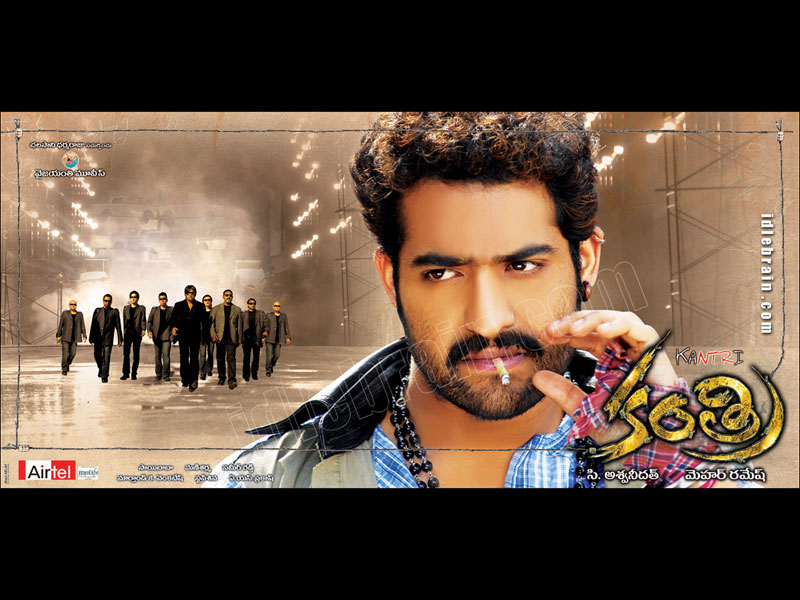
A note on KANTRI (Telugu; 2008) and the NTR Legacy


[Warning: this piece contains spoilers.]

Kantri is a rather run-of-the-mill film (there's a complete review here), and would be unremarkable were it not for the film's symbolic staging of the biography of its hero, NTR Jr. Although much of the film's first half focuses on the impending clash between underworld don PR and local tough Kranthi (NTR Jr.; Kantri ("avenger") when he's in a bad mood, or should I say "kaNTRi"?), the film's second half sees NTR Jr.'s character revealed as the long-lost son of PR (who first came into wealth by murdering the character played by Mukesh Rishi, and his son and daughter-in-law; he abandons his wife and child at the same time). Once this is revealed, NTR Jr. goes to live with his father (albeit reluctantly; for his part, although PR is happy to have Kranthi with him, he also characterizes him as rough, and akin to a "laborer" who needs to be "groomed").

This sort of representation enables NTR Jr. to play the obligatory populist card (in the film, Kranthi is never defensive or apologetic about being "lower class," and in fact brings along with him all the children from the orphanage where he has apparently grown up in), a card that enables NTR Jr. to lay claim to his grandfather NTR's populism (even if, in NTR Jr., the inheritance is refracted through the post-Bachchan angry young man persona that has become the norm for Telugu and Tamil films). This story arc also alludes to the sidelining (long gossiped about in Andhra) of the real-life NTR Jr. by the more "senior" branches of the NTR family -- at this point in the film, the audience is expected to supplement the drama of Kranthi's return to a house that rightfully should always have been his, yet one which he feels is populated by his enemies; with what everyone knows about NTR Jr.'s real life.

It doesn't end here: the twist in Kantri reveals the above to have been a lie all along: Kranthi is not in fact PR's son, and has in fact been choreographing a charade to exact revenge on PR on behalf of Kranthi's grandfather, revealed to be none other than Mukesh Rishi's character -- thereby enabling a symbolic settling of scores with an intermediate generation standing between the two NTRs, grandfather and grandson. And also, of course, inscribing NTR Jr. as the real heir of NTR Sr.'s legacy.

The above reading illustrates why the (all too common) critical view of masala films that focuses solely on elements internal to the plot, while remaining oblivious to the universe of signification within which these elements operate, can only result in an impoverished reading. Equally, however, Kantri doesn't simply re-stage the long hallowed myths of Telegu/Indian/Hindu culture. It does this only in the most general (and even covert) ways. What the film is directly concerned with, however, is the staging of a modern mythology, namely the cult of NTR and his legacy, in the form of family members who also became actors; NTR Jr. is one of multiple descendants, although he is the most successful, and the most plausible heir, inasmuch as he is widely held to closely resemble NTR. (And make no mistake, it is the fact of this lineage that enables the cult to become a dynastic inheritance.) This is what makes Kantri, more accurately, the NTR Jr. phenomenon, new (the Sarkar franchise is the only other that comes to mind). Not all of NTR Jr.'s films "stage" the family biographical drama as obviously as this film, but it is not uncommon for NTR Jr.'s films to intermittently invoke "real life" -- in Yamadonga, for instance, NTR Jr. steps out of character to invoke his grandfather in Yama's kingdom (the late NTR obliges with a digitized appearance) -- that is, in films like Kantri, the NTR Jr. phenomenon doesn't allude to broader cultural myths so much as to the myth of itself. The off-screen alluded to is not unconnected to the actor at the film's center, but is simply the "real life" of the actor. Equally, the actor is, in a sense, only required to play himself (a most difficult role, as far as I am concerned, since one has to make the myth of oneself plausible with hardly any reference to naturalism.)

Monday, August 03, 2009

PASANGA (Tamil; 2009)


If you're looking for a plot, Pasanga isn't the film for you: it's essentially about the boy Anbukkarasu (Kishore), who shows up at a government (Tamil-medium) school after his none too well-off father decides (over the discontent of his wife) that the family can't afford the English-medium school the children have been attending. On his first day at the new school, Anbukkarasu tangles with the sixth-grade mafia, three thuggish kids led by Jeeva (Sriram), who quickly takes a violent dislike to the nerdy gunner who's joined his domain. Meanwhile, Anbukkarasu's uncle Meenakshi Sundaram (Vimal) and Jeeva's elder sister Suppikanu (Vega) strike up a (to this viewer, annoying) romance. The obligatory inter-family feud follows, as everyone is dragged into the hostilities between Jeeva and Anbukkarasu. By film's end... well, I told you Pasanga wasn't about the plot.

Most Hindi and Tamil films feature the sort of children adults would like to have, models of cuteness more akin to pets than kids. Not Pasanga: far more successfully than any film I can think of since Shekhar Kapoor's Masoom, Pasanga so relentlessly draws the viewer into the world as seen from the vantage point of its nine- or ten-year old protagonists, that despite the manifest absurdity (to the jaded adult eye) of the children's antics, jokes, ambitions about ranking "first" in the class, and eternal concern with being shown up and humiliated before their peers, one cannot help but internalize the children's worldview. So much so that when the film interrupts this arc with the adult romance, one is impatient to get back to the "real" guts of the film. The Meenakshi-Suppikanu love story seems monstrously implausible -- it probably isn't any more so than the ones in most films, but the difference is that we just don't have much patience for it. Not when the child actors offer so much verve and fraught emotion (albeit unevenly so: there is much unwelcome saccharine mixed in too), and ultimately, psychological plausibility. (The adults do not fare as well, especially the two fathers: Anbukkarasu's is insipid, while Jeeva's father manages to lurch from inconsistency to inconsistency without ever threatening to interest one.)

Debutant director Pandiraj is evidently, like his producer Sasikumar (who in turn directed Subramaniapuram (2008)) in the forefront of what Baradwaj Rangan has called the New Tamil Cinema, characterized by generally lower key proceedings (a turning away, in effect, from the high octane bombast that threatened to reduce all Tamil cinema to masala actioners with heros doing all sorts of impersonations of Nandi The Bull), greater sensitivity (potentially, to the point of fetish) to "ordinary" locales and socio-economic environments, and the casting of relative unknowns as leads -- all in the service of thoroughly commercial movies. If films such as Pasanga, Paruthiveeran, Anjaathe, Kaadhal, 7G Rainbow Colony, and Veyil constitute the beginnings of a movement, the jury is still amount on what it will amount to. But for a viewer fed on a steady diet of Hindi films set in Sydney, London, New York, wherever, and with almost cretinous reflexivity, this is exciting: not because of any patronizing promise of vicariously experiencing an (imagined) authentic "other" over the course of a two-and-a-half hour film, an authenticity that one is denied access to; but because these films seem interested in telling stories and representing characters (the two don't necessarily go hand-in-hand: Pasanga is focused on the latter to the exclusion of the former, and the film is not the poorer for it), not in peddling lifestyles or protagonists-as-advertisements.

Moreover, while notions of "authenticity" can hardly be accepted uncritically, a film like Pasanga unquestionably aims to represent a certain specificity -- of place, of class, of condition. None of this is above critique, but when evoked as effectively as in Pasanga, it is most assuredly cinematic. Pandiraj doesn't (for the most part; the film's disappointing opening sequence is an exception) tell you what these kids are up to -- he shows you. Perhaps it is that quality in Pasanga that reminds Rangan of Fellini (I'm assuming it isn't just the unembarrassed scatological references) -- and while I cannot say that I detect here the beguiling sprawl of Fellini (or the sheer mastery over the medium), one sees what Rangan might be getting at. At its best, the directorial eye behind Pasanga aims at creating a world, not in making sense of it. (Witness the scene when the two boys' families -- who live opposite each other -- let a spat between their sons snowball into warfare between the families. That sequence could be from any number of Tamil films -- except for the sound of a vendor yelling out news of Diwali sales on a megaphone, that weaves into the midst of this quarrel, even drowning it out at points -- a sign that the world does not stop for this conflict, that this isn't the Mahabharata, just an unseemly squabble.) Given that so many directors seem to see their job as essentially filming scripts, Pandiraj's entry to the industry, while far from perfect, is welcome indeed.