Saturday, June 27, 2009

Anonymous


It is odd to mourn the loss of a building one has never seen, the significance of which one does not know, the absence of which one will never feel. And yet that's precisely where I found myself yesterday, as BBC correspondent Sam Miller's voice interrupted my treadmill reverie:
Most evenings, just before sunset, I walk or run in a huge secret park in the heart of modern Delhi. It is really a jungle with footpaths, known only to those who live close by. . . . Two summers ago, back in my local jungle park, I found another ruin, in an area of wilderness so thick with undergrowth that I had to beat my way through it with a stick. There, long-forgotten, was half a mosque, a tree growing out of one of its walls, but the perfect rosettes and squinches created by artisans 700 years ago still intact. I tried to interest my friends and fellow journalists in my discovery of an unlisted ancient mosque in the heart of modern Delhi. I told people about it at Delhi parties and they yawned. I telephoned a leading historian of the medieval Sultanate period, who promised he would get back to me. A guide book writer did come to see and she told me it will be mentioned in the next edition. But I failed to get anyone else half as excited as me.

Miller's pleasure (the photograph he took is enclosed above) would soon be tinged with more than melancholy at the indifference of those around him:
On my return I went back to the mosque and discovered that my co-ordinates were correct. . . . The mosque had gone.
It had been bulldozed and there was no sign it had ever existed. The wilderness had become a building site and squash and badminton courts were being built for - yes - the Commonwealth Games. No-one made a fuss and I have found it hard to make the case that this archaeologically super-rich city is much poorer without one old tumbledown mosque. And though I have been able to immortalise it in photos and text in a book I wrote about my adoptive city, I am also aware that it is just one of dozens of minor ruins that have disappeared in recent years. And more will almost certainly go as the pace of development continues to accelerate. Delhi is a city that is more proud of its future than its past.


Miller's own monument is unlikely to last as long as the mosque did, but I couldn't help but feel grateful at his determination to preserve the trace as best he could. Of such cussed and quixotic sentimentality is memory made. I was reminded of my own visit to Firozabad in 2006, the remains of one of Delhi's medieval capitals, but not one of the modern city's busy tourist sites. Perhaps it was just as well I had the place to myself: the ghosts would have abhorred a crowd, although they do tolerate the occasional prying tourist, and the school children (from cramped houses they share with far too many people for any quiet corners) studying for their exams:


How Not to Reach a Peace Deal

In recent months, there has been some discussion in the media of how close India and Pakistan were to reaching a peace agreement settling the Kashmir dispute, before Pakistani President Pervez Musharraf was ousted from power by a popular movement galvanized by Musharraf's attempts to hold on to power by nakedly manipulating Pakistan's judiciary. I have previously expressed skepticism about the truth of such claims about the prospects for a peace deal, but perhaps the more important question to be asked is why, after six years of a "composite dialogue" process and numerous "people-to-people" exchanges, the Indian and Pakistani publics know so little about what their leaders have been saying to their counterparts on the other side, or what the contours of an ultimate deal might look like, or how to get there. This isn't a purely academic question: such mass ignorance ensures that Indo-Pak contacts remain -- even at the best of times -- at a relatively apolitical level, restricted to, for instance, cricket and hockey tours; liberalized visit visa regimes; or low-level trade across the Line of Control dividing Indian-held from Pakistani-held Kashmir, etc. None of these are trivial measures, and I welcome each of them -- but none of these goes any significant way toward preparing the people of India and Pakistan (including the people of the two Kashmirs) for a political settlement (specifically, for the compromises, disappointments, and challenges that must attend any settlement) -- with the result that even minor setbacks (let alone catastrophes like the Mumbai attacks of November 2008) lead to a resurgence of the old anxieties and frustrations, as if no peace process had ever intervened.

It isn't hard to see why leaders prefer to conduct talks in secret: premature (or indeed any) disclosure of negotiating positions, or intimations that one might accept the other side's positions, would likely help mobilize constituencies opposed to the particular proposal, and perhaps to the process in general, potentially derailing them. But the leaders of India and Pakistan have erred too much in the other direction: over the last few years, the substance of talks between the countries have been so confidential that the people of the two countries have known practically nothing about them, beyond that negotiations are taking place. The aim seems to be to present the public with a fait accompli, and then dare it to demur; rather than build support for the substance of what a peace deal might ultimately look like. Over the last five or six years, the governments of India and Pakistan have periodically stressed the desirability of peace, and the necessity of the two sides negotiating -- but have never attempted to secure a mandate (much less forge a consensus) on what the contours of a peace deal might look like. Rather, we have been treated to after-the-fact instances of this or that figure insisting that the parties were one stroke away from an ultimate deal. Not only does the cloak and dagger air of these negotiations make any such claims impossible to verify, but it raises serious questions about the viability of any peace deal that resulted from such a process. It may not be wise to expose every twitch of the peace turtle to the light of day, but to keep the animal under wraps over its entire lifespan smacks of weakness and fear, not the combination of determination and optimism that is needed to make peace between India and Pakistan. [For instance, with respect to the claims that the Musharraf and UPA governments were close to a final peace agreement on Kashmir, one notes that Kashmiri representatives do not appear to have played a meaningful role in the process; it beggars belief that the governments of India and Pakistan continue to believe -- at this late date -- that any solution can simply be presented to Kashmiris. The contours of this deal are not the point -- the deal India and Pakistan supposedly almost struck seems like a pretty good one to me -- the unacceptability of any deal to Kashmiris absent their participation in the process resulting in an agreement most certainly is.] Asif Ali Zardari and Manmohan Singh would do well to keep the failures of the last six years in mind -- beginning, above all, with the failure to take the people of the two countries into even minimal confidence, a monumental failure of the political imagination -- as the foreign secretaries of the two countries prepare to meet next month, in the first sign (since last November's Mumbai attacks) that the countries are prepared to move forward on the peace process.

Thursday, June 25, 2009

Stupidity

The recent unrest over the alleged rape and murder of two women in the Kashmiri town of Shopian (that has led to massive protests, with very many people convinced that the perpetrators were Indian army personnel -- so far, evidence to that effect has not been unearthed, although given the general culture of impunity within which uniformed men seem to operate in India when it comes to sexual assault, not to mention in Kashmir, the conviction is a plausible one) has clearly rattled the state government (Chief Minister Omar Abdullah didn't help matters by sticking his neck out early on and claiming that there was no evidence of sexual assault, a claim belied by the autopsy report). So much so that the government has apparently resorted to bullying cable TV operators for showing too much news:

As the protests grew in intensity, information dissemination became a cause of concern for the Omar Abdullah led National Conference-Congress coalition government in the state. It reacted by imposing a crackdown on local Cable TV channels. In its June 6 directive to them, it asked them to limit their news telecasts to 15 minutes a day. The channels were asked not to report anything which goes against the taste of the government and do not give much coverage to the activities of the separatist groups or the protests staged by the masses. . . . [P]rior to imposing curbs, the owners and editors of Cable TV channels in Kashmir were summoned by the authorities and threatened that they had better "behave properly". Editors say the meeting was more of a threat than any discussion on Cable TV reporting. During the meeting, editors were accused of the receiving funds from All Parties Hurriyat Conference, a conglomerate of various separatist organsations operating in Jammu and Kashmir. LINK


Evidently, the cleaner, more transparent administration promised by Omar Abdullah comes replete with a thin skin. [Not to mention that it exposes the absurdity of a media (at least the English-language portion of it) that was utterly complicit in projecting Abdullah as a break from the past, as representing a new start, etc. But as was no less true of Rahul Gandhi, such attitudes spoke volumes about the relative youth and telegenic personae of the candidates in question, and nothing at all about any substantive policies offered by these scions of political dynasties of rather old vintage (Omar Abdullah, for instance, is the son and grandson of Kashmiri Chief Ministers; his father, Farooq Abdullah, simply vacated the CM-in-waiting spot in favor of his son, preferring to be a federal minister in the Manmohan Singh government, a reversal of the NDA-years when the father was CM of Jammu and Kashmir, and the son a federal minister), beyond mouthing banalities like "good governance". Who anyway says (s)he is for bad governance? The bankruptcy of political discourse in the mainstream English-language Indian media (specifically, its insistence on presenting "good" politicians as those who are apolitical providers of good governance, which is nothing more or less than an anti-democratic fetishization of technocrats) never ceases to amaze me.]

The work of the Jammu and Kashmir state government is made easier by the sorts of laws in effect nationwide, that have severe consequences for freedom of expression. Consider this gem from the Cable Television Networks (Regulation) Act of 1995 (Chapter V, Paragraphs 19-20; emphasis mine):
Power to prohibit transmission of certain programmes in public interest. Where an officer, not below the rank 'Of a Group 'A' officer of the Central Government authorised by the State Government in this behalf, thinks it necessary or expedient so to do in the public interest, he may, by order, prohibit any cable operator from transmitting or re-transmitting any particular programme if it is likely to promote, on grounds of religion, race, language, caste or community or any other ground whatsoever, disharmony or feelings of enmity, hatred or ill-will between different religious, racial, linguistic or regional groups or castes or communities or which is likely to disturb the public tranquillity. . . . Where the Central Government thinks it necessary or expedient so to do in public interest, it may prohibit the operation of any cable television network in such areas as it may, by notification in the Official Gazette, specify in this behalf.

According to one media source (emphasis mine):
The Deputy Commissioner (DC) Srinagar in his notice to various Cable TV channels has given a reference of the Cable Television Network (Regulation) Act, 1995 guidelines saying that no programme should be carried on Cable network which:
Offends good taste or decency.
Contains criticism of friendly countries.
Contains attack on religious communities or visuals or words contemptuous of religious groups or which promote communal attitudes.
Contains anything obscene, defamatory, deliberate, false and suggestive innuendos and half truths.
Is likely to encourage or incite violence or contains anything against maintenance of law and order or which promote anti-national attitudes.
Contains anything affecting the integrity of the nation.

Such laws are not only more worthy of the British Raj than of India's democracy; they are uncommonly stupid: in the context of a state like Jammu and Kashmir, they do not help counter secessionist sentiment, but simply foster a suspicion of all institutions -- a cynicism that is, in the long run, far more harmful to the Indian polity than whatever the state government is afraid the TV channels might show. [Such laws are in effect across India, of course, and not just in Jammu and Kashmir; but, are far less likely to be enforced to the fullest extent in a non-secessionist context; although even here, the example of the Emergency three decades ago shows there is no room for complacency.]

None of this is to absolve the irresponsibility of much of the Kashmiri media (not to mention, perhaps more charitably, the intimidation it is subject to from pro-secessionist groups in addition to the state), but the government's cure is worse than the ailment. For a fascinating piece on media coverage of the Shopian murders, see HERE.

Tuesday, June 23, 2009

Obama. Irshaad.

This one is too good to pass up: Obama recently told an interviewer (from DAWN, Pakistan's leading English-language newspaper):

'I would love to visit [Pakistan]. As you know, I had Pakistani roommates in college who were very close friends of mine. I went to visit them when I was still in college; was in Karachi and went to Hyderabad. Their mothers taught me to cook,’ said Mr Obama.

‘What can you cook?’

‘Oh, keema ... daal ... You name it, I can cook it. And so I have a great affinity for Pakistani culture and the great Urdu poets.’

‘You read Urdu poetry?’

‘Absolutely.'

Read the rest at POLITICO. Thanks to Tyler for bringing this to my attention! The complete interview with DAWN's Anwar Iqbal is on the newspaper's website.

Monday, June 22, 2009

Lalgarh


[A few related posts here, here, and here.]

In the wake of the Maoists declaring Lalgarh (in West Bengal's Midnapore district) a "liberated zone", the state and central governments last week decided to move against the Maoists, amidst the usual (and breathless) media focus on the military/police action -- and utter disregard for the material conditions that might have led "tribals" in Lalgarh and elsewhere to support the insurgents. Indeed, one CNN-IBN podcast spoke (with no trace of irony) of the liberation of Lalgarh as proving difficult, in part because most of the tribals there were sympathetic to the insurgents! Just who or what is being liberated here? Not too many Naxalite leaders give interviews to the English-language media, but the Lalgarh crisis seems to have changed that for the moment, as even the Naxalites have woken up to the value of public relations: see, for instance, here, here, and here, for first-hand encounters with some Naxalite voices:

...You see, power doesn’t come through weapons alone. Look at the people of Lalgarh (where tribals seized administrative power after the police allegedly tortured some of them on the suspicion that they were harbouring Maoists)—with just home-made bows and arrows, they have stalled police. Guerilla operations depend a lot on people’s support and because people are with us, we have managed to keep the police from reaching us. Our party runs on an annual budget of Rs15-20 crore. That’s what we spend on our operations across the country, and it’s almost the same amount that we raise through donations, seizures and heists. Most of the money is raised in Dandakaranya, Bihar and Jharkhand. ...

...There is no end to revolution. There is no time frame—it seems it will take time… But, if the war strategy is right, we’ll reach our goal soon. Otherwise, we will have to retreat and change course. But we are strictly against joining mainstream politics. Over the last few years, politicians such as Sonia Gandhi and Buddhababu have been advising us to follow the example of Maoists in Nepal, but look at what happened to them. I met Prachanda several times and told him that they were on the wrong track and urged him to change his political stance. We won’t make the same mistake. ...

...I don’t have kids. Our party doesn’t support the idea of having children. There is no ban as such, but the leadership expects the women in our party to undergo sterilization after marriage. This is done to ensure that their political careers are not compromised. ...LINK


One hardly needs to be a Naxalite sympathizer (I am not) to observe that the system has failed "tribals", and nowhere more so than in eastern and central India (in Chattisgarh alone, as Anand Teltumbde recently noted in an incisive piece, "over 100,000 people have been displaced and hundreds of villages abandoned, besides the killing of hundreds in the crossfire between the police and the Naxalites"; the likes of Andhra Pradesh have a somewhat better record -- although that isn't saying much -- of responding to the concerns represented by the Naxalite movement by incorporating some of them (along with erstwhile Naxalites) into the political mainstream) -- and the ruling Left dispensation in West Bengal is not (ideologically) nimble enough to inspire much hope on that front. As Nandigram showed, its response to contemporary ideological challenges has been limited to throwing in its lot with industrial "development", no matter how many farmers have to be displaced; in one fell swoop transforming the Comrades in West Bengal from proletarian revolutionaries to neo-liberal champions of "development" eminently acceptable to the very middle classes once scorned by them. A reminder, if any were needed, that India needs an alternative to Communism in terms of the progressive political space, one that speaks in terms of the Indian polity's great "tribal"-shaped (and Dalit and minority-shaped, though these groups fare better) and perhaps even modernity-shaped blind spots, not in the rhetoric of post-industrial class struggles that even the CPI(M) has trouble taking seriously anymore. As the country negotiates the challenges of twenty-first century globalization, a "post-modern" political ethic is a necessity; India can ill-afford the luxury of a Left simultaneously operating along the political axes of a 1960s time warp, and an authoritarian pro-heavy industry paradigm.

Aditya Nigam has an interesting piece on Kafila about the possibility that was Lalgarh, before the area became a battleground between armed Maoists and state forces: a must-read.

Saturday, June 20, 2009

DARKNESS AT NOON (1940): A Note

Darkness at Noon: A Novel Darkness at Noon: A Novel by Arthur Koestler


My review


rating: 3 of 5 stars
An excerpt from Darkness at Noon was included in an English class anthology in middle school, and I had always meant to follow up on Rubashov's travails in the face of the Communist purges of the late 1930s. A chance glimpse of this bright red cover at McNally Jackson nearly two decades later served as my madeleine, and who can resist nostalgia?

Rubashov, it turns out, was not the innocent I had imagined from my textbook excerpt, but instead, a lynchpin of the Revolution and the Communist Party, who had helped build the very system that in time would devour him (and who has himself sacrificed many an innocent on the altar of Revolution, and the redemption-by-history it promises). Yet his is no mere youthful revolutionary fervor turned sour: rather, Rubashov remains a true believer almost to the very end, and even as he faces conviction and death remains open to the possibility that "No. 1" (a thinly disguised Stalin) might even be right in liquidating the Rubashovs who represent the Revolution's founding generation.

Rubashov's uncritical acceptance of Marxist-Leninist orthodoxy, in particular the "objective" nature of the Marxist-Leninist view of history, makes Darkness at Noon seem more than a little dated, but the book's representation of a system where the notion that the ends justify the means has been taken to its logical (and monstrous) conclusion, where the individual is a mere speck against the backdrop of History (and the favorable verdict it promises), remains permanently relevant. As does the dramatic tension of Rubashov's various interrogation sequences. But the novel seems a bit abstract when it moves away from those sequences, as if Koestler were working out an intellectual puzzle rather than recounting the the fate of Rubashov (and in him, that of an age). Indeed, this reader found himself wondering whether the book might not have worked better as a play consisting only of the interrogation scenes: their distilled terror and intensity (by virtue of their representation of a looming inevitability that is simply a function of the absolute pitilessness of the system, and of the juxtaposition of the frail individual with that system) is ideally suited to the theatrical space.


View all my reviews.

Friday, June 19, 2009

Lights, Camera, Politics! -- II (from Chapati Mystery)

Following-up on this thread, here's more from Chapati Mystery (mine and other folks' comments follow purdah's post The Silver Screen War).

Sunday, June 14, 2009

Film Review: FRONTIER GANDHI (2008)


The Frontier Gandhi: Badshah Khan, a Torch for Peace, directed by T.C. McLuhan; screened on June 14, 2009 at the Brooklyn Academy of Music, as part of the Muslim Voices festival.

The sheer incongruity of Khan Abdul Ghaffar Khan (1890-1988) merits some explanation. He lived most of his life on the wrong side of history and political geography: his championing of Pashtun causes in the 1920s and 1930s did not win him the friendship of the British Raj (which ruled the Pashtun lands east of the Durand line as part of British India's North-West Frontier Province ("NWFP")); over time, his Khudai Khidmatgar (Servants of God) movement became the only mass-based predominantly Muslim movement in (what is today) Pakistan to be allied with the Indian National Congress in the struggle for independence -- which, by the 1940s, meant that he had to contend with the rising tide of the Muslim League and its demand for Pakistan (not to mention a colonial authority that was far more suspicious of the Khidmatgars than of the League); he couldn't simply be an Afghan nationalist, given that he was born on the side of the Durand line not ruled from Kabul. Finally, he and his movement became misfits in the post-1947 political dispensation, the man himself branded a traitor by the ruling establishment in Pakistan, a Gandhi-lover in a nation-state founded on the two-nation theory. Yet none of this can detract from the fact that Khan was the driving force behind the most (only?) organized Pashtun mass movement of modern times, a force so potent that even six decades after the NWFP voted to join Pakistan in a referendum (the only one of its kind in the sub-continent), "Badshah" ("King") Khan's brand lives on, in Pakistan, by means of the Awami National Party ("ANP"), a Pashtun-centric political party run (for the most part) by his descendants; and in India, by means of Khan's induction into mainstream nationalist historiography's pantheon of heros, as the very archetype of the "good" Muslim.

Yet traces of the man's "difference", his strangeness, remain, defying easy assimilation: his championing of Pashtun nationalism, on both sides of the Durand line, cannot sit comfortably within the Nehruvian project (a problem Indian textbooks have dealt with by passing over it in silence); his preference for an un-partitioned India over Pakistan if the option of "Pashtunistan" was off the table is even more incomprehensible to mainstream Pakistani discourse than Pashtun nationalism is; and his frank religiosity would make the Indian Left uncomfortable. The oddness extends to his physical appearance: he seems immensely tall in the newsreels and photographs, with powerful, yet gentle, eyes, and a nose the size of which beggars belief. Badshah Khan was, quite simply, the echidna of sub-continental politics, the patron saint of all desi political oddities who have never found a home in the region's post-colonial states.

It should thus come as no surprise that the mass movement Khan built is like a compendium of stereotype-busters: fanatically non-violent in a violent region, and composed of people defined -- by both colonial and post-colonial authorities, by "Westerners" as well as by native "others" -- as essentially and irredeemably violent; progressive in a milieu where the term is reserved for secular dispensations; and inter-religious in a place and time when communal identity came to become all but synonymous with political destiny. The story of Khan and the Khudai Khidmatgars touches upon virtually every significant political concern in three South Asian nation-states (India, Pakistan, and Afghanistan), and is yet practically unknown outside the sub-continent, and simplistically understood within it. All of which is a rather long-winded way of explaining just why I took the train one balmy Sunday afternoon, from Spanish Harlem all the way to the Brooklyn Academy of Music, when I heard that a documentary on the great man's life was going to be screened as part of a festival called "Muslim Voices."

Unfortunately, McLuhan's documentary is nowhere near as interesting as a film on Badshah Khan should be, largely due to a prism that insists on beatifying the man, on representing him as a now-forgotten prophet, rather than as the fascinating political animal he was. The film's title is thus no accident, for Mahatma Gandhi has himself long been consumed by Western audiences as a saint, rather than the enigmatic, frustrating, and great political leader he was. For Frontier Gandhi, as for the Eknath Easwaran book that McLuhan says inspired the film, Khan Abdul Ghaffar Khan is an almost other-worldly figure, an incarnation of humanistic love, his philosophy of non-violent resistance simply an expression of that love. This is all well-intentioned, and certainly none could deny the ethical import of the tactics championed by Khan and Gandhi, but the effect is not only simple-minded, but downright pernicious. For Khan to tower as the Pashtun Jesus, he must be set against a hopelessly lost people, and an ethos where the only natural thing to do is to fight and kill. As noted above, this is a common stereotype, both in the sub-continent and in the West, but overuse has certainly not dulled its edge (indeed, I have myself heard the Pakistani military's recent interventions in the region justified on the ground that the Pashtuns only appreciate force). Nor does it explain anything: watching this documentary does not enable one to get even a glimmer of how and why Khan's message was able to resonate in the NWFP of his day, how he was able to build up such a formidable organization, and why the movement was not more successful in preventing partition, or even of winning the allegiance of more Muslims (not to mention whether or not Khan's call for a boycott of the 1947 referendum, was a political blunder). Frontier Gandhi gives us, instead, a glimpse of the sacred: we see the holy man in grainy newsreels, while modern-day acolytes profess wonder at his goodness; in short, a devotional, not a documentary (although admittedly one with the benefit of introducing "the West" to an aspect of Pashtun history that has hardly gotten any attention in the post-9/11 world; for a serious engagement with that history, check out Mukulika Banerjee's wonderful The Pathan Unarmed).

Nevertheless, there is much to redeem Frontier Gandhi: despite the problematic framing of her subject, McLuhan allows Badshah Khan to "speak", through scattered doses of his writings (narrated by Om Puri), and audio clips of the man's own wonderfully rich, measured voice. And then there are the videos, very many of them, enabling the audience to catch glimpses of the man, even if he's doing pretty much the same thing in most of them (namely, greeting people) -- and there are some memorable exceptions, such as the excerpt from a very late interview of Khan's wherein he warns that the best solution to the Soviet invasion of Afghanistan is a negotiated one, lest the conflict engulf everyone; or videos of his trip to India in 1969, replete with Indira Gandhi looking at the audience rather than paying any heed to the man speaking at the podium; or one from the 1940s, when an animated Jawaharlal Nehru throws his arm over Badhsah Khan's shoulder. Last, but certainly not least, McLuhan has done the audience a great service by including extensive footage of interviews with surviving Khudai Khidmatgars, from both Pakistan and India. Their ardor and conviction, and (at times) their sorrow and disappointment, shine through. Taken together, the audio/video clips and the interviews take the documentary in a different direction than the one McLuhan (or interviewees like Saeed Naqvi, Eknath Easwaran, and M.J. Akbar) appear to have had in mind -- a far richer and more authentically grounded direction. For those testimonials to a lost world, and to an abiding conviction, this film deserves to be seen.

Tuesday, June 09, 2009

The General (or, Why The Film Would Be No Better As A Rerun)

Ex-Pakistani president Pervez Musharraf has been on a mission to burnish his image for some time now, after a cooling off period immediately following his ouster in the face of a committed and inspiring "lawyers' movement" (but not only the lawyers' movement) for democracy. A recent interview in Der Spiegel makes clear that his belief in the centrality of the military to Pakistan's national project (and, presumably, of his own centrality to the cause of the nation) is as strong as ever:

Nothing can happen to Pakistan as long as the armed forces are intact and strong. Anyone who wants to weaken and destabilize Pakistan just has to weaken the army and our intelligence service, ISI, and this is what is happening these days.


Classic military self-righteousness from the man who left Pakistan a much bigger mess than he found it; and implicit is the world-view of the Pakistani military as an uber-caste serving as the only reliable guardians/guarantors of the nation. This sort of PR-drive is part of the wider context of the military's offensive against the Taliban in Swat -- whatever one might say about the merits of opposing the Taliban, there can be little doubt that the Pakistani military is using the opportunity to refurbish its tarnished image, to impress upon all Pakistanis who might oppose it that in times of stress, that only the military can save them. Such image-making is par for the course in many countries -- but given the context of Pakistan's hard won electoral freedoms, and the enduring influence of the military-intelligence apparatus(es) on Pakistan's public life; and given, above all, the all-too-frequent tendency of Pakistan's urbane classes toward facile despair with the venality and inefficiencies of civilian politicians (and consequent acceptance of the more systemic corruption of a military regime, especially one clothed in neo-Ataturk garb) -- Pakistan's democrats (or at least those not too busy cheerleading the military, rather than asking how and why three million people need to be displaced to deal with 4,000 militants) ignore this move at their peril. As does an international community that might yet remain wedded to the vision of a Pakistan that was simply "better managed" under Musharraf, and hence that the man might need to be brought back in some way, shape, or form. Pakistan doesn't need authoritarian "management"; it needs more chaotic renewal, more civilian politics (even if corrupt and sordid), and more reform, of the sort which underpin democracies around the world.

[Aside: with respect to Musharraf's claim on how close India and Pakistan were to resolving the Kashmir dispute (uncritically repeated by sections of the Indian English-language media), I remain skeptical: even if Musharraf's proposals were as set forth here, they were apparently made at precisely the time when Musharraf's internal position within Pakistan was weakening beyond repair in the face of the chief justice controversy/lawyer movement, etc., and thus come across as a desperate attempt to shore up his position. But no-one likes to do deals with weak people they think might not be around to guarantee implementation and continued observance, and I suspect India was of the same mind. The notion that "transit routes" were the main stumbling block is a little hard to swallow, especially given that a Muzaffarabad-Srinagar bus-service was inaugurated a few years ago, and that India recently eased restrictions on who could be a passenger. None of this is to suggest that India isn't a past master at never missing an opportunity to miss an opportunity (its apparent obliviousness to the Kashmiri separatist movement's renunciation of violence last year is a case in point), but simply that Musharraf's claims here need to be taken with a rather large dose of salt.]

Sunday, June 07, 2009

A Scene from NAYAK (Bengali; 1966)


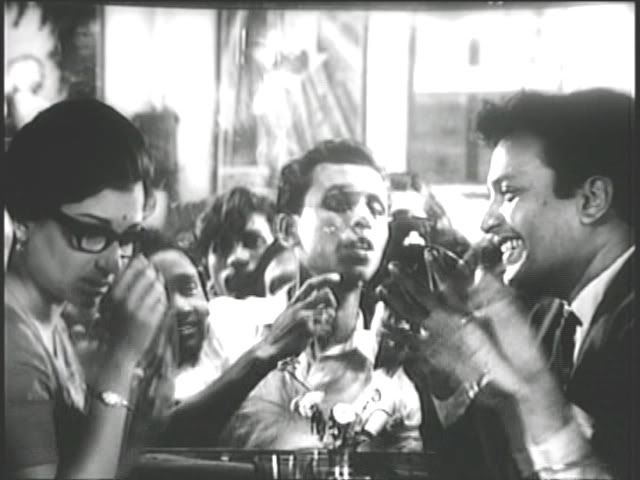
There's a superb sequence in Satyajit Ray's Nayak (Bengali; 1966) where the film-star (played by Uttam Kumar) is talking to a young (and inexperienced, at least where cinema is concerned) female journalist in a railway dining car; the train has stopped at a station, and there is a crowd with its faces pressed against the window, clearly unnerving the journalist (played by Sharmila Tagore); Ray even adds an inspired touch, the ceaseless tapping of the fans' fingers on the window, that not only affects Tagore's character, but also gets under the audience's skin, preventing the scene from being a "comfortable" one for it. Through it all, Kumar's character feigns indifference, the sort of Olympian reserve that, one imagines, might well add to his fans' yearning; and is amused at his female companion's discomfort. Many gazes are in play here: the theatre audience watching the crowd at the train station; the latter itself clamoring for the star's attention; and the celebrity, enjoying the attention, watching the journalist's discomfort; and the journalist herself, hitherto perhaps a bit smug at (what she has imagined is) the shallowness of the celebrity's life, embarrassed by the attention, and feeling the weight the star bears every public moment. I cannot think of a better cinematic representation of the star's aura, of the star's position vis-a-vis the audience.

Satyam commented on the same scene here.

Wednesday, June 03, 2009

JOHNNY GADDAR (Hindi; 2007): A Follow-Up

As a follow-up to my review of Sriram Raghavan's Johnny Gaddaar, and in connection with MasterPraz's review of the film:


I loved the sequences involving Seshadri (Dharmendra) and his dead wife, and Seshadri's tape of her crooning the “Mora gora angh lai le” song from Bandini (vaguely reminiscent of Krapp's Last Tape -- given what Vikram (Neil Mukesh) does to him, it certainly is Seshadri's last tape)): in evoking the image of an “old world” and aging thief out of sync with more ruthless times today, Raghavan also evokes a bygone era in Bollywood, be it by way of the references to films like Bandini, Jonny Mera Naam, or Parwana. Neil Mukesh’s character might be inspired by the Dev Anand starrer to take "Johnny" as his name for purposes of his plan to rip-off his partners in crime, but his generation has turned ghaddaar (traitor), slaying the father to grab what’s his. Standard Freudian drama, except that this is about cinema (not an Oedipal contest over the mother), and hence the woman singing the song from Bandini is long since dead, and (for the audience) the (cinematic) era she hearkens to, long past. Leaving the living fighting over scraps.