Friday, September 25, 2009

A Note on Two Satyajit Ray Charmers...


[Image courtesy Ballygunge Government High School Alumni Association.]

One of my great pleasures is exploring a master's minor work -- often it is only in the latter, especially when one has attained canonical status, that some vestiges of the whimsical remain. Strictly speaking, this is only partly true of Satyajit Ray's work (he actually seemed to get more whimsical with age and directorial maturity), but nevertheless, an acquaintance with the Ray of less serious subjects is highly rewarding. One isn't overawed, but most decidedly charmed.


[Image courtesy Rodney Koeneke's blog Modern Americans: Poetry, Poetics, Portland. I urge readers to check out his suggestive reading of Joi Baba Felunath.]

The two Detective Prodosh Mitra films I saw recently certainly fit the bill: Sonar Kella ("The Golden Fortress"; 1974), an odd little tale of a boy who is apparently obsessed with images from a past life, and endangered when the promise of treasure associated with that past life leads to two criminals to abscond with him; and Joi Baba Felunath (1979), a more conventional detective story about a missing idol of Lord Ganesh in Varanasi, are both as compelling as fables, but in a comforting manner. One has never any doubt that Detective Mitra (Soumitra Chatterjee) will get to the bottom of everything, and the films thoroughly partake of the pleasure of detection, the pleasure to be obtained from uncovering secrets and figuring things out -- a pleasure that almost seems anachronistic to me, inasmuch as I think of it as a quintessentially nineteenth century (and English?) sentiment; as well as of the whimsicality of a Tintin adventure. (This is especially true of the older film, and Ray acknowledges as much in a seemingly casual shot of Mitra's cousin and sidekick Topshe (Siddhartha Chatterjee) reading a Tintin comic on a train.) It is perhaps the supernatural element that makes Sonar Kella the superior film, so saturated with atmosphere one is sorry to be parted from it when the film ends. But with respect to both films, Ray effortlessly manages to convey what too few directors are capable of: the condition of being a traveler. When the characters in these films travel to an "exotic" location (Jaipur, Bikaner, and Jaisalmer, all feature in Sonar Kella; the later film is set entirely in Varanasi), the audience -- no matter where it is from -- is also taken out of its comfort zone, and transported. One can only wonder how much more effective these films would be with high-quality DVD transfers: especially in Sonar Kella, the faded colors do not do justice to Ray's visuals of Rajasthan.


[Image courtesy CalcuttaWeb.]

No reflection on these films could ignore Soumitra Chatterjee, a Ray favorite. His Prodosh Mitra is a model of languidness and stylized understatement, in the process elevating dowdy dhoti kurtas and kurta pyjamas into Bengali babu chic, and generally providing both these films with the calm poise of a center. Which isn't to say other characters aren't important, especially the baddies, ranging from the pint-sized slimeball Mukul Dhar (Kushal Chakravarti) in Sonar Kella, to the fantastic villain of Joi Baba Felunath Maganlal Meghraj (Utpal Dutt) -- the latter especially welcome for Hindi film viewers who are more familiar with Dutt as the lovable presence from so many Hindi film comedies from the 1970s.


[Image courtesy the wonderful Satyajit Ray Film & Study Center, University of California, Santa Cruz.]

Sunday, September 20, 2009

WANTED (Hindi; 2009)


[Image courtesy NDTV]

The passage of time does strange things, but not even Marcel Proust could have dreamed it would have this effect. I've spent most of the last two decades disliking Salman Khan. I mean, really disliking him, and everything about him: from his wannabe vibe, his faux-Bambi eyes, his breathless dialog-delivery, his weird English accent, and his non-existent acting skills. Needless to say, I wasn't much convinced by his occasional half-assed attempts to do masala actioners; he was -- and there's no polite way to put this -- just too puny for the likes of Garv, especially given that he was playing it straight, as opposed to using the sort of explanatory gimmick Aamir Khan deployed (namely, that he was a raving lunatic) in Ghajini.

But then, a funny thing happened on the way to 2009: masala cinema went the way of the dodo, leaving adherents like me to whatever slim pickings remained (mostly by way of remakes of Southern superhits, such as the unsuccessful-but-enjoyable Run (2004), and the ultra-successful Ghajini (2008) (both remakes of Tamil films of the same names, from 2002 and 2005, respectively; and both directed by filmmakers from that industry)); and Salman Khan, after an indifferent run at the box-office, began hosting a TV game-show called Dus Ka Dum. The Salman of the latter was a revelation, funny and irreverent, and most interestingly, possessed of a new persona that almost seemed to parody "Bollywood." Certainly, there were occasional glimpses of this in Salman's oeuvre, such as in the brilliant opening scene of Jaan-e-man (2006), or in David Dhawan's underrated Trishul-spoof of sorts, Yeh Hai Jalwa (2002), but something as sustained as Salman's Dus ka Dum avatar is rare in an industry where far too many take themselves far too seriously (and with far too little justification). Wouldn't it be fun, I mused, if someone managed to cast this Salman Khan in a film, preferably a masala movie?

Had I known God was listening, I would have wished for the winning lottery ticket.

Wanted is, consistent with the trend of Bollywood's seeming inability to come up with a decent masala actioner, a remake of Pokiri (2006), reportedly Telugu cinema's then-biggest grosser -- or is it Pokkiri (2007), Prabhudeva's Tamil remake of Puri Jagannath's Telugu original? No matter: Prabhudeva apparently likes the script so much he's decided to re-re-make it, this time with Salman Khan standing in Mahesh Babu's can't-be-bettered shoes, or in Vijay's less impressive Tamil running gear.

He's not getting better at this: while Wanted is an almost-exact ersatz of Pokiri, it is a markedly lesser film. Some of this is attributable to Puri Jagannath, who managed to infuse the original with a certain fluidity that lent itself to repeat viewing (the far clunkier Wanted does not). But most can be laid at the door of Mahesh Babu,in his prime and capable of powering along the rather patchy narrative -- and make no mistake, this is the kind of film that rises or falls with its male lead.

Mercifully for Prabhudeva, his male lead -- Salman Khan -- is in possibly the best form of his life. Now well into his forties, age has begun to show as much as it has with his peers Aamir and Shah Rukh (and, for all three, to a greater extent than with Akshay Kumar), and Salman's dance and action-movements betray a marked stiffness at points in Wanted -- but, with the exception of his dignified and iconographic cameo in Saawariya (2007), Salman Khan has never looked better or more charismatic (when dressed normally, that is; Prabhudeva all too often clothes him in outlandish wear befitting an actor half his age -- it doesn't help that the female lead, Ayesha Takia, probably is half Salman's age). He certainly has never looked more convincing in action sequences (the most intense of these, the climactic one, betters the analogous sequence in Pokiri). And, given that this is the story of ruthless thug Radhe (Salman), his love interest Jhanvi (Ayesha Takia, whose effervescent persona is utterly wasted in a role that ought to be beneath her), the sleazy inspector who lusts after her (Mahesh Manjrekar), and who, like Radhe, ultimately works for underworld don Ghani Bhai (Prakashraj), himself pursued by a ruthless new assistant commissioner of police (Govind Namdeo), there are plenty of opportunities for action sequences (indeed, Wanted is markedly gorier than Pokiri). Salman handles these with gusto, if not quite aplomb. More importantly, his hyper-stylized screen persona fits right in where this film is concerned; and Salman deploys it in a bemused manner that borders on self-parody, to the point where one could be forgiven for imagining a twinkle in his eye. And Prabhudeva gives him the works, from seeti-taali inducing dialogs to fisticuffs to gunplay to smoldering face-time with Takia; heck, by film's end, he even has his shirt off. No Salman fan could possibly complain about this outing.

The above is a longwinded way of saying that the failure of this film cannot be laid at Salman's door. If one had been hoping for Prabhudeva to improve on Pokkiri's script, one would be disappointed. The original was not powered by a classic script, and although the Hindi version lops off much of the unwelcome comedy track, it feels no tighter. Nor does it have adequate substitutes for the zing of Pokkiri's one-liners, attempting to make do with more double entendres and crudity than the Telugu film had (when Jhanvi is backed into Radhe in a stalled elevator, she is jolted, and timidly asks what has happened; Radhe informs her that's his cellphone on vibrate-mode, and Jhanvi obligingly moves her ass to confirm for the audience this is indeed the case). Far from diluting the sexism that marred Pokiri, Wanted might even have ramped it up. In the context of the ultra-girlish Takia, paired with a man who looks old enough to be her father, some of these dialogs can seem positively creepy. (Not to mention the fact that just about every woman in both films is associated with some instance of sexual coercion.) I can't say I regretted seeing the film -- I'm too starved of masala cinema for that -- but it does give me pause before any recommendations are handed out. And I won't be seeing it again -- not as long as I can access the DVD of Puri Jagannath's film...

Thursday, September 17, 2009

Book Review: THE PASSING OF PATRIMONIALISM

The Passing of Patrimonialism: Politics and Political Culture in Hyderabad, 1911-1948; by Margrit Pernau; New Delhi: Manohar, 2000 (earlier version published in German as Verfassung und politische Kultur im Wandel : der indische Fürstenstaat Hyderabad 1911-48; Stuttgart: F. Steiner, 1992)


Original Photo HERE

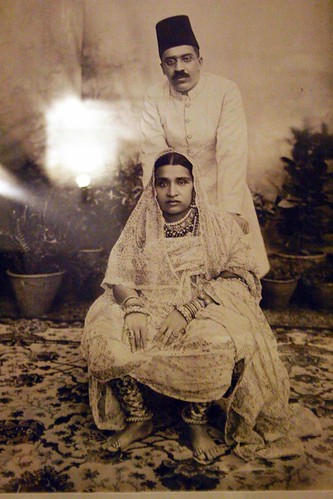
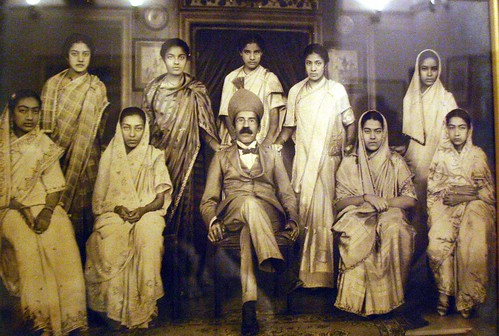
The incredible wealth and personal oddities of Hyderabad's last Nizam, Osman Ali Khan; combined with the striking anomaly that the Deccan outpost of, and successor-state to, the Mughal empire -- it is no coincidence that the graves of Aurangzeb and the first Nizam lie very near each other, in the Burhanuddin dargah in Maharashtra’s Khuldabad -- survived until the middle of the twentieth century; not to mention the state's bizarre decision to try and cling on as a monarchy even after the departure of the British, rather than strike a reasonable accommodation with the post-1947 Indian state; have contributed to the dominant popular image of the Nizamate, and of its court culture, as one of eccentricity and anachronism. If ever a polity was in the wrong time, popular historiography seems to agree, the Mughal relic in the Deccan was it. Margrit Pernau's first achievement in The Passing of Patrimonialism, then, is in taking and representing that polity seriously for a relatively non-specialist audience. Her book (the English version is a 2000 reworking of her 1992 German-language study) attempts to take the reader through the last four decades of British rule in India from the perspective of (for the most part) the Nizam's court and Hyderabad's political elites. While the Pernau of 2000 acknowledges that her 1992 thesis' implicit conflation of "politics" with the statecraft and maneuvers of the Hyderabad political elites is a bit too narrow given the book's subtitle, she unapologetically insists upon the subject's importance. One would be hard-pressed to deny it, although Pernau's concession does mean that one cannot take the book's stated ambit, "Politics and Political Culture in Hyderabad, 1911-1948", literally. The "patrimonialism" of the title refers to Max Weber's classification of the forms of "traditional " political authority in his seminal Economy and Society. Following Weber, Pernau notes:

. . . three forms within traditional authority, that is authority which derives its legitimacy 'by virtue of the sanctity of age-old rules ('existing since time immemorial') and powers. The first form is gerontocracy or primary patriarchalism, which functions without an administrative staff of its own and therefore can exercise control only over a limited area. . . . If an administrative staff develops, it can be responsible to the ruler personally -- the second form. In this case Weber speaks of patrimonialism. Alternatively -- and this is the third form -- it can appropriate particular powers and economic assets, in which case it would be called estate-type domination. . . . (Passing of Patrimonialism, pg. 51)


The "passing" the book's title refers to is thus that of Hyderabad from the pre-modern "patrimonialism" of the Asaf Jahi state to the modern, impersonal bureaucratic state. But the bureaucratic state Pernau apparently has in mind is not simply the Indian Union. While Hyderabad is commonly thought of in popular discourse as stuck in a time warp until its old order was replaced by virtue of the state's absorption into the Indian Union in 1948, Pernau sees the transition as having begun much earlier, such that the ancien regime was already all but dead by the time the Indian Army walked into the state. In Pernau's view, the passage from the second to the third of Weber's forms of "traditional authority" was initiated by the last Nizam, Osman Ali Khan (r. 1911-1948), who sought to create a modern administrative state structure that would nevertheless leave undisturbed the legitimacy and symbolic order of the Asaf Jahi dynasty, a monarchy that bore the trace of its distant Mughal origins in the sovereign's own title (the "nizam" of the title referred originally to Mir Qamaruddin Khan, the eighteenth century Mughal "nizam-ul-mulk" ("administrator of the land", a title given to Mughal governors) who founded the dynasty by achieving the de facto independence of the declining Mughal state's Deccan province). But The Passing of Patrimonialism isn't very clear as to whether this bureaucratization was the result of the last Nizam's own drive for centralized power (at the expense of that of other traditional elements in the state, such as the nobility); or of the Raj's determination by the 1920s to clip Osman Ali Khan's wings, by attempting to institutionalize administrative authority in the state in order to reduce its dependence on a man the British alternately regarded as bulwark and troublemaker.


Original Photo HERE

The book's failure to explore this distinction points to a wider issue. An account of Hyderabad's broader passage from the world of the "beloved" Nizam Mahboob Ali Khan (d. 1911) (held, along with his Minister Maharajah Kishen Prashad, to typify the traditional Hyderabadi courtly ethos) to that of the modern nation-state, would unquestionably be highly significant (whether or not even pre-1911 Hyderabad conformed to Weber's notions of the "patrimonial," given the size and extent of the state, and the fact of British paramountcy and range of "impersonal" means at the colonial power's disposal to influence events within the state, is a separate question). But The Passing of Patrimonialism only intermittently concerns itself with such an account, and even less so with a study of the state's increasing bureaucratization, with the result that the book's statement of thesis, laid out in Pernau's introduction, is somewhat misleading. Pernau does engage with her book's purported subject when it comes to discrete areas -- such as her superb account of the manner in which the patrimonial (and perennial) struggle between the aristocratic Paigah family and the sovereign, with the contours of Paigah power varying over time and dependent on the nature of the family's relations with the Nizam -- became institutionalized by the end of the 1920s, the rights and privileges of Paigah seigneurial authority over the family lands becoming appropriate subjects for legal/rule-based adjudication, rather than informal politics. But for the most part, the book does not provide an overarching account of a system passing into bureaucratic modernity. Indeed, at its most persuasive, such as in the long fifth chapter on the new forms of political mobilization in the twentieth century, the resulting sharpening of linguistic and communal boundaries as well as the simultaneous fluidity of the boundaries between the Indian nationalist, Hindu revivalist, and linguistic movements; and on the extent to which even orthodox Muslim "loyalism" ultimately undermined the polity; the book's account of the passing of Hyderabad's patrimonial structure does not seem to have anything to do with the increased bureaucratization of the state. The nazar controversy of 1920 serves as a good illustration. Osman Ali Khan's re-interpretation of the Mughal concept of nazar, from a personal presentation to the sovereign as homage, or at the time of a request; to an institutionalized (and highly unpopular) revenue stream collected throughout the realm; would appear to be a perfect illustration of the book's thesis. But Pernau discusses the issue only within the context of rising tensions between the Nizam and the British, and other critics who saw the new policy as evidence of Osman Ali Khan's avarice. A study of the new nazar policy as symptomatic of the passing of patrimonialism is strangely absent.


Original Photo HERE

Fortunately, the tale Pernau does tell is no less significant. The Passing of Patrimonialism is essentially a history of Hyderabad's politics during Osman Ali Khan's reign, and, given the paucity of overarching scholarly narratives on this subject in English, it is welcome as such a history. Ultimately, the broader historical passage Pernau's title alludes to is not the subject of her history so much as it is the backdrop to her account of the efforts of the Hyderabad ruling elites to negotiate both British paramountcy and the rising tide of nationalism, all the while attempting to preserve the old order. Pernau's book, that is to say, is not a study of the last Nizam's modernization drive as symptomatic of a long structural change, but is primarily a history of his strategy to negotiate that change. That strategy was doomed to fail -- Osman Ali Khan's regime ultimately found itself on the wrong side of virtually every major political trend, with the exception of the increased bureaucratization that was one of modernity's hallmarks, or of an overtly Muslim politics, although even both of these could not help but undermine the foundations of the ancien regime that had encouraged them. However, an adequate understanding of that attempt, that is, of Osman Ali Khan's position as a crucial transitional figure -- a "modernizer," but one who sought to use modernization to try and shore up his position and to hold outsiders at bay -- is essential, not only where the political history of the Deccan is concerned, but also because it encapsulates several major themes in Indian history that resonate down to our times: the dichotomies of "tradition" and "progress"; cultural autonomy and "outside" influence; the functioning of colonialism in the context of "indirect" rule; the grand narratives of nationalism and communalism (Muslim and Hindu); the more localized narrative of a sub-national (Telugu, but also Marathi) identity; not to mention (by the end of the period) an armed peasant uprising.

Original Photo HERE

The Passing of Patrimonialism is very good in illustrating the unintended consequences of political actors pursuing their own ends within the context of the hybrid colonial system that combined directly ruled British India with a patchwork of "native ruled" states, and over which (certainly by the late nineteenth century) British authority and influence was such that their characterization in the academic literature as instances of "indirect" rule is entirely justified. Pernau lucidly shows how, step-by-step, and cognizant of his early weakness within Hyderabad vis-a-vis the nobility and the throne's Minister (given that the appointment of the latter had long been one of the principal ways in which the colonial power exercised influence at the Hyderabad court, the position was an especial interest of the British, and, over time, no Minister could be appointed without British approval) the last Nizam sought to shore up his authority by courting the British Resident and importing (or accelerating the adoption of) British bureaucratic models within the state's administration; while, simultaneously, attempting to instal his own men in significant administrative positions. (The latter move adversely impacted the traditional aristocracy, and, indirectly, British influence, given the nobility's tendency to appeal to the British Resident for support in conflicts with the court.) This double (and somewhat contradictory) move would have been fairly typical of the dance the larger princely states had to manage vis-a-vis the Raj (the double move would become a trapeze act once nationalistic politics gained ground in the twentieth century, as India's new "mass leaders" challenged the legitimacy of the "traditional" rulers in profoundly destabilizing ways), were it not for the outbreak of World War I.

Pernau underscores that the British need to "keep Muslims loyal" in the face of an enemy that included Ottoman Turkey (still ruled by a Sultan who was nominally Khalifah (Caliph) of all (Sunni) Muslims worldwide) led them to solicit the overt support of the Nizam, as the ruler of the largest Muslim(-ruled) principality in India. This need became ever more urgent once it became clear that the war's end would spell radical changes to the nature of the Ottoman state. Not to mention that complications arose from Britain's position as global -- and not just an Indian -- power: while the British had extended assurances to Indian Muslim leaders that the position of the Khalifah as custodian of the holy places of Makkah and Madinah would not be affected, these promises were simply inconsistent with the expectations of Arab nationalists (also encouraged by the British) that henceforth they would rule in the Arab lands. While the Nizam's combination of loyalty and subservience to the Raj, and championing of a specifically Muslim agenda, would pose problems once the Khilafat movement made the two courses diverge, until that break, on Pernau's account, the Nizam was able to see his position as "Muslim leader" as an opportunity to leverage his relations with the Raj in his favor. However, what neither the Nizam, nor the British (nor anyone else) foresaw was the destructive impact the Nizam's new pan-Indian Islamic identity ("new" in the sense that it was understood to transcend the borders of the state of Hyderabad; the Asaf Jahi dynasty had always seen itself as orthodox Muslim, but had not laid any claim to wider Muslim significance beyond the Deccan, and had over time celebrated the notion of a court culture where Hindu and Muslim could not be distinguished on the basis of language or dress) would have on the legitimacy of his state in the eyes of its own population, the vast majority of which was Hindu.


Original Photo HERE

What explains this blindness? One might just chalk it up to the inevitable law of unintended consequences, but Pernau links it to the ambiguous duality inherent in the position of the princely states vis-a-vis the Raj. That is, the princes were expected to maintain "traditional" rule within their borders, but at the same time had to follow the British "civilizing" lead (a ruler who stubbornly refused to implement any of the modern bureaucratic, administrative, educational, and technological methods being applied in British India, would soon find himself -- as an unfriendly reactionary -- on the wrong side of the state's British Resident). Conversely, the princely states could not go the whole hog in conforming to the British model: not only would this be suicidal for the native rulers' own position (which to a large extent depended on traditional symbols and models of patronage, few of which could survive the impersonal bureaucratization of the modern state), but it would also undermine the Raj's own rationale for why the princely states continued to be tolerated. That is, if the British were justified in letting the princely states survive despite their "backwardness", this was because "traditional authority" was better suited to Indian realities, and indeed, the Indian public was imagined to be greatly attached to the traditional forms of authority. (The cynicism of such justifications may be readily gleaned from the obvious point that this essentially relativistic argument could just as easily be used to undermine the ideological foundations of colonial rule in British India. Pernau, more charitably, refers to this unacknowledged contradiction within British imperial ideology, but that presupposes an integrity that I am not persuaded imperial policymakers possessed.) Wholesale importation of the British model would de-stabilize the traditional bond between prince and subject. The "traditional" rulers also began to serve a second ideological function once Western-educated Indians began to lead the nascent nationalistic movements: in contrast to the likes of the urban, Anglicized Indians who showed signs of making greater political demands than the Raj was prepared to grant; the nawabs and maharajahs could be held up as representatives of the "real" India. The (pre-Gandhi) Indian nationalists might have been "civilized" by means of their Western-style education and orientation, but that also made them un-Indian in the eyes of the colonial power, and hence un-representative. Progress, the Raj's message appeared to be, came at the price of political irrelevance.

In sum, the princely order was already accustomed to grappling with two systems, and even two symbolic orders; one applying to the native state's dealings with the "external" power, and the second applying to its dealings with its own people. On Pernau's telling, the Nizam (presumably in common with the other princes) did not appreciate that the second system could be profoundly affected by the vagaries of the first. Thus, the "external" approach of presenting the Asaf Jahi ruler as natural leader of India's Muslims, and custodian in some vague sense of Indian Islam, was not perceived to have any bearing on the Nizam's relationship with his own subjects. To the extent Pernau is right, the Nizam was no more wrong than the other princes about the relationship between "outside" and "inside". However, as the ruler of the largest native state, and the only one who had become implicated in pan-Indian symbolism, only the Nizam was playing such a high-stakes game. And Hyderabad was one of the handful of large states where the ruling family and the majority of the population belonged to different religions. Pernau is surely right to pinpoint the dovetailing of British and Nizam interests in Osman Ali Khan's adoption of pan-Indian Muslim garb, as setting the stage for a communal disaster within Hyderabad. The nationalistic mobilizations and communal conflicts that engulfed India in the decades after World War I would likely have made things challenging for the polity in any event, but the Nizam posing as Muslim champion made the destruction of his regime's neutrality, and, ultimately, its legitimacy, inevitable. Not to mention that the shift would also come to restrict the Nizam's room for maneuver where proponents of a specifically Muslim politics were concerned; by the 1940s the state was regularly bullied and co-opted by the fanatics of the Majlis-e-Ittihad-ul-Muslimeen (although the significance of the Nizam's own cynicism in encouraging the Majlis in order to undermine other power centers within Hyderabad; and Jinnah's opportunism in forging an alliance with the likes of Majlis leader Bahadur Yar Jung as part of the Muslim League's drive to present itself as India-wide representative of all Muslims, whether in British India or the princely states, cannot be underestimated either). By the time of Hyderabad's collision course with the post-1947 Indian state, Pernau notes that the old order had in any event become irretrievable: the Nizam still reigned, but his rule was becoming an empty shell in the face of a de facto coup d'etat by the Majlis's military wing, the Razzakars. In the wake of nationalism, while democratic politics ended up undermining the legitimacy of princely rule all over the sub-continent, the same politics also served to renovate many a prince as Member of Parliament or Minister after 1947. But Hyderabad's particular constellation of events meant there would be no re-invention for the Nizam and his descendants as modern politicians. Like that other state that lay directly across the fault-lines of the transfer of power from Britain to its successor states, namely Kashmir, the former ruling family in Hyderabad is today utterly absent from the public life of its former realm (except as the subject of news stories about ongoing litigation concerning the family fortune), in a way that would be unimaginable where the erstwhile rulers of the Rajasthan states, or Gwalior, are concerned.

Original Photo HERE

But The Passing of Patrimonialism overstates the case when it asserts that Osman Ali Khan's re-orientation of his throne as leader and symbol of India's Muslims was not intended to have any bearing on the throne's relationship with its non-Muslim subjects. That is, Pernau ascribes tactical, but not ideological, significance to this move where the Nizam was concerned. But it is difficult to square this with Pernau's own account of the last Nizam's "attitude towards the Hindu-Muslim question" within Hyderabad (pgs. 150-151): what policy could be less likely to maintain Hyderabad's internal Hindu-Muslim equilibrium than the virtually complete sidelining of Hindus from the highest echelons of the cabinet after 1924 -- especially given that the same period saw the first Hindu-Muslim riots, and the arrival of the Muslim tabligh and Hindu nationalist "re-conversion" drives to the Nizam's domains. Doubtless Osman Ali Khan was no closet Majlis ideologue, but it is hard to shake the impression that he was (or grew) susceptible to the puritanical political Islam espoused by the likes of Osmania University's Habib-ur-Rahman and (later) the Majlis. The last Nizam probably did not have any radical moves in mind, but Pernau devotes insufficient attention to his encouragement of a shift in emphasis where the bases of his rule were concerned, in favor of a more overtly Muslim garb for the state.

The final act of this communal drama was grisly indeed: Pernau estimates that "one tenth to one fifth of the male Muslim population" was massacred in the conflagration that followed the Indian army's entry into Hyderabad in September 1948, as the Razzakar oppression of Hindus during the Nizamate's last years was apparently followed by indiscriminate massacres and violence against Muslims, "primarily in the countryside and provincial towns." (Pg. 336). The claim (which Pernau mentions in passing, citing the work of Omar Khalidi, Wilfred Smith, and a few others) is startling, not just because carnage on this scale is more commonly associated with the 1947 violence (especially in Punjab and Bengal), but because attention on human rights violations during this period has tended to focus on Razzakar atrocities against the peasantry prior to the Indian army action, and on the army's own human rights violations in the wake of the "police action." The latter pale in comparison to the sort of violence Pernau mentions, and I do not know if this lacuna in so many writings on the period points to the factual unreliability of the claim that so many were killed, or to the scandal of a most under-studied example of the sort of "popular" mass killings (perpetrated not, or not simply, by the arms of the state, but by large populations) that Mahmood Mamdani discusses in his permanently useful study of Rwanda When Victims Become Killers. In such circumstances, the horror of violence -- by victims whose sense of historical grievance unmoors retributive violence from any sense of "measure" -- is shocking not just because of its brutality, but because it is experienced by perpetrators as liberation. Intriguingly, my (admittedly anecdotal) experience discussing this issue with a couple of people from Aurangabad and Hyderabad points to disbelief, even among Urdu-speaking Muslims, that the killings could have occurred on such a scale. This too is in stark contrast to the situation vis-a-vis the 1947 Partition massacres: while in both situations, notions of community honor and shame contribute to reluctance to discuss the violence (especially sexual violence), except in general terms, everyone seems ready to acknowledge its scale (even if primary responsibility is often sought to be foisted on the "other" religious group). Where Hyderabad is concerned, there is an almost complete absence of discussion of the sort of popular violence Pernau references, except in the general sense of an instance, even if extreme, of recurrent Hindu-Muslim communal violence. Nor can it be simply a question of blotting out a trauma, since my sense is that it is not difficult to solicit reports of atrocities by the Indian military. Perhaps the fact that the brunt of the violence would have been borne in villages and smaller towns, as opposed to in larger urban areas where the Indian military was able to exercise control relatively quickly and effectively, offers an explanation. The urban masses, whether elite or subaltern, Hindu or Muslim, and especially in the nerve center of Hyderabad city, would not have experienced the singularity of violence on the unprecedented scale Pernau notes; what they would have experienced might well be accountable by means of narratives of "normal" Hindu-Muslim violence, or of the end of an old order (the fall of the Nizam's regime). But the fact that Pernau seems to be one of the few authors who has even tackled the issue -- and it is hardly the main focus, even of her work -- leaves the lay reader in the uncomfortable position of trying to decide whether the silence is itself a singular historical phenomenon worthy of study (apart from, of course, the fact of such a carnage, which ought to inform a whole host of historical and political narratives; The Hindu carried one of the few popular articles on the issue in 2001); or if it raises questions about the scholarship underlying the claim of this many killed. Stated crudely, one finds oneself asking whether Pernau, Khalidi, and Smith, et al., are right as far as the number of those killed is concerned (the fact of widespread massacres is not in dispute, given the anger and concern expressed by none other than Jawaharlal Nehru upon hearing of the reports, not to mention the sources cited in the Noorani article in The Hindu), in a way one never needs to where the other, academically well-plowed massacres of India's atrocious 1940s, are concerned.


Original Photo HERE

Although The Passing of Patrimonialism doesn't quite justify its title and introduction, it is invaluable as a study of the government-level politics of Hyderabad during the reign of the last Nizam. This is so despite the fact that Pernau's book leaves the reader none the wiser on the question as to why Hyderabad's political elite pursued (at least once it became clear that the departure of the British was imminent) a policy that does not need the wisdom of hindsight to be described as suicidal. How is one to account for this blindness, right to the bloody and bitter end? Perhaps it couldn't be otherwise, given the book's focus on strategy and maneuver, and its relative indifference to the ideology of the narrative's principal figures (apart from the ethos of the traditional nobility, sketched as backdrop at the book's outset). Equally, however, the mystery might be a function not just of this study's limitations, but of the sparsity of the historical record in key respects -- unlike their rather prolific counterparts in British India, many of the prime movers in Hyderabad during this period (including the Nizam and the Razzakars) left few private papers that have been made public. Moreover, the Nizam had many policies implemented orally, and, as Pernau notes, on occasion in direct contradiction of the written policies (principally in order to satisfy the British with respect to a particular demand, while actually creating facts on the ground to opposite effect). The foregoing, and the intersection of the ritualized forms of Mughal court practice in the context of a thoroughly modern colonialism, combine to lend an air of kabuki to the proceedings that the historian is charged with deciphering. However, The Passing of Patrimonialism is superb in evoking the practice of colonial statecraft in the context of indirect rule. That practice -- conducted in an elaborate dance of letters, personal interviews, "advice" from the British Resident, appeals and counter-appeals to (and reprimands from) the Viceroy in Delhi (and even, by the 1930s, to politicians in London), and ministerial intrigues -- is masterfully recreated by Pernau's judicious marshaling of a wide range of sources, and drives home, both the reality of indirect rule and the ceaseless attempts of the princes to try and game the system, however rigged.


Original Photo HERE

Pernau memorably offers a glimpse into the true nature of that system by means of her discussion of the Nizam's attempts to call into question the nature and basis of British paramountcy, in order to regain control over the province of Berar (leased to the British under dubious circumstances since the mid-nineteenth century, the arrangement confirmed in perpetuity since the early twentieth; apparently leading Mahbub Ali Khan to joke that his G.C.B. award actually stood for "Gave Curzon Berar"). Confronted with a claim that was legally sound, the Raj was forced to articulate the naked force (as opposed to liberal conceptions of the rule of law and treaty rights) that ultimately underlay British supremacy vis-a-vis the princely states, a supremacy "not based only upon treaties and engagements, but exist[ing] independently of them”; it was, after all “the right and the privilege of the Paramount Power to decide all disputes that m[ight] arise between States, or between one of the States and itself." (March 27, 1926 letter from the Viceroy to the Nizam, quoted on pgs. 143-44). In our post-9/11 world, when nostalgia for the British empire and arguments for new imperial arrangements have become commonplace in the writings of both academics (such as Niall Ferguson) and popular writers (such as Robert Kaplan), we would do well to keep the crude honesty of Lord Reading's words in mind, both for what they teach us about the nature of imperialism, and for, as Pernau shows, the distorting effect the cloaking of the latter has on the politics of the governed. None of this predetermined the Nizam's utter lack of political realism or wisdom in the final analysis. But, as Pernau recognizes, the manufacture and maintenance of shadow sovereignties increasingly divorced from reality, and essential to effacing the nature of colonial rule in the eyes of "indirect" subjects, surely incentivized a system where reflexive conflation of form and substance, and a disastrous over-estimation of the latter based on the former (especially when the increasingly hollow form remained decked out in the iron clad regalia of solemn treaties with, and political guarantees by, a colonial power that, in the final analysis simply decided to wash its hands of the mess and leave), was a real possibility:

While in former times symbols had been an impressive language understood by both the British and the princes, a language in which the struggle for power was conducted, by 1930 the British had forgotten all they ever knew about the relationship between the signifier and the signified. Consequently they no longer regarded symbols as signs but as substitutes for real power and used them accordingly. Hyderabad remained tragically unaware of this change; part of the overestimation of its own power, which ultimately led to its downfall, can be traced back to this. (Pg. 220)

Tuesday, September 15, 2009

CHAMKU (Hindi; 2008)


The first sequence gets you. It's aboard a train -- as so many of the best action sequences are -- and Bobby Deol, his hands bound, is being escorted to an unidentified gangster, along with a young woman supplied from Varanasi for the gangster's pleasure. Her bright-red shalwar qameez simply underscores her nervousness; not the the gangster cares, pulling her to him even as he yells at his men to kill Deol's character and throw him off the train. At that point, a cell-phone -- within the woman's brassiere -- rings, and all hell breaks loose, as the narrow passages of the train erupt in gunfire and good ol' action. Can't keep a hero down, even with his hands bound.

The hero is Bobby Deol, looking better than he ever has, and shrewdly cast in a taciturn role that doesn't feature much dialogue, namely that of Chamku, the son of a farmer from Bihar's badlands. After he is brutally orphaned by the evil thakur Mahendra Pratap Singh, little Chamku is taken in by a Naxalite commander (Danny Denzongpa), and grows up to be the latter's right-hand man. Assassinating a local politician in the midst of a lewd Holi song? No problem. Unfortunately for Chamku, arrest means encounter death for the entire cadre; Chamku himself only survives because he's the hero, and can;t possibly be felled by a few bullets. He comes to in the hospital, only to find himself face to face with the sinister Mr. Kapoor (Irfan Khan), making him an offer he can't possibly refuse: a position on a "dirty squad" being formed by the Indian government's intelligence agencies to carry out all sorts of nefarious acts within the country. While Chamku doesn't exactly throw himself into the job with glee, his world is thrown into turmoil, first by the sight of schoolteacher Shubhi (Priyanka Chopra) -- in the sort of sari-blouse that ensures full attendance by the class -- and second, by a chance encounter with the evil thakur, who seems to have made the transition from backwater oppressor to Mumbai builder with great ease. As the New York Lotto line goes: Hey, you never know.

The story is improbable -- or, more accurately, a tale that begins with a promise of a realistic depiction of some of India's seamier realities, ends up flirting a little too intensely with the sort of masala mash that needs commitment from the word go in order to be convincing -- but the director is Kabeer Kaushik (of Seher (2005) fame), which guarantees that Chamku is suffused with a seriousness of tone and purpose that belies the outlandish plot. And if the film doesn't live up to its early promise, it nevertheless remains the best Bobby Deol film you've never seen. And that's just wrong: Kaushik's sophomore effort is never less than engaging, principally because of his splicing of a routine narrative by means of several time shifts; and his superb use of Bobby Deol in what has to be the man's best action outing; and a nonchalantly evil turn by Irfan Khan, who represents a kind of bureaucratic evil. Irfan's Kapoor doesn't appear to be animated by patriotism, love, hatred, etc. -- he (and his boss, played by Rajendra Gupta) just want(s) the job done. Other Hindi films have featured corrupt government agents -- but Kaushik's film is the first to evoke a "system" that is steeped in immoral ruthlessness, that views itself as entitled to transgress its own laws in its own land. Seher was unquestionably the more gripping film, but Chamku pushes the envelope further. I wish I had seen it earlier.

A word about the cinematography: Gopal Shah's work is strongest in enclosed public places -- trains, crowded malls, alleys -- and he clearly loves focusing on his hero negotiating these spaces. It's a solid effort, but interesting enough to warrant better projects than the likes of Heroes (2008). The music director is Monty (of Saawariya (2007) fame), and while old-school Holi songs and item numbers aren't his natural element, he gamely tries, resulting in some energetic music (heck, there isn't much other Holi music to go with, so I'll certainly go with the catchy Gola Gola). The real standout is the restrained Dukh ki Badri -- while not a match for Saawariya's Daras Bina Naahi Chain, Kalpana, Shail Huda, and Parthiv Goel, infuse this folkish track with genuine feeling, and a gravitas that stays with the listener.

Friday, September 11, 2009

Music Review: BLUE (Hindi; 2009)


Outright fun, not to mention silliness, has long been a casualty of A.R. Rahman's recent Hindi oeuvre. Unlike in Tamil, Rahman simply hasn't done very many soundtracks for "ordinary" Hindi films of late. That is, the typical Rahman Hindi album this decade has been a Swades or a Jodha-Akbar, or a Delhi-6 -- not a Rangeela or a Daud. The last year might well be the beginning of a shift, with Ghajini, and now Blue. No song in either album will ever make a list of Rahman's best, but equally, no-one can doubt that at their best, these albums feature a more playful Rahman, the sort of souffle-lover one missed in the likes of Jodha-Akbar. On the down-side, at its worst, the likes of Blue do give the impression of a composer who hasn't lavished much care on his work. Luckily for us, the balance comes down on the side of buying the album.

Fiqrana began with a nod to Ghajini's Kaise Mujhe Tum Mil Gayeen, but then, when it seemed one of the Mahesh Bhatt stable of composers had taken over the song, my heart sank -- not that there is anything wrong with those neo-Pakipop songs, it's just that such generic music is unworthy of Rahman. At the fifty-five second mark, I realized how wrong I was as Vijay Prakash's voice segued from the familiar sounds of a number filmed on Emraan Hashmi to the more rhythmic, almost drunk "Jeet te hain hum larh larh ke"; and then, after about ten seconds of the addictive loop inaugurated by those words, the song begins to soar with "Hum mehekte ... gulzaaron mein". By then, this listener was hooked, with no possibility of escape. This song doesn't soar very far in terms of complexity, and will never be a major Rahman song; but it remains a song that insinuates itself into the bloodstream, and demands to be heard dozens of times -- or not at all. That the maestro has not lost his taste for light musical confectionery after all these years in the industry is worth celebrating in itself; but the extent to which this song's edges have been smoothed out in keeping with the film's aquatic theme (in no small measure due to Rahman's effective deployment of Shreya Goshal's voice), means this sweet dish will go down easy. This track is worth the price of the album.

There is more breeziness in this album: Aaj Dil Gustakh Hai is twice as light as Fiqrana, and half as interesting; and while Sukhvinder Singh's voice is always welcome on a Rahman composition, the duo do not break much new ground here, resulting in a song that is musically faultless but quite safe. That doesn't mean you'll be skipping this song. Far from it: think of Aaj Dil Gustakh Hai as the Ocean's Eleven of this album -- smooth, suave, utterly charming, and rather pointless. Given the song's video trailer features Sanjay Dutt and bikini-clad Lara Dutta cavorting on a beach and on board a boat, this track seems like it is just what director Anthony D'Souza ordered.

Rehnuma features Goshal and Sonu Nigam at their charming best, and the somewhat portentous effect created by the juxtaposition of their old-school crooning with a relatively overwrought orchestral backdrop makes this a more interesting song than it otherwise might have been. However, there is something missing from the song, a certain fun quotient that was needed to justify a song its musical arrangement does not get all the way there. At least on a first listen: of all the tracks in this album, this one is most likely to gain by repeat listening.

No-one will ever accuse the delightfully throwback Yaar Mila Tha of lacking a fun quotient. Fittingly enough, Rahman resorts to Udit Narayan for the male vocals here, with Madhushree's faintly over-ripe voice playing the female part. The song is best thought of as Rahman's attempt to turn his gaze toward the sort of rollicking love song Hindi film music just doesn't see much of these days (replete with lyrics like "har maa kahe bete se, laa aisi dulhaniya"). That he is doing so self-consciously is indicated by the early soft-jungle beat reminiscent of a rather different vibe, namely Daud's "Shabba Shabba"; and by the decidedly contemporary hip-hop groove the song ends with. It all adds up to this album's best shot at timelessness, a song that should be as un-dated ten years from now as it is today.

Bhoola Tujhe is another relatively simple composition, elevated by a chorus that soars several notches. The song's mellow anthemic vibe is in keeping with its subject -- Rashid Ali's vocals are addressed to the Creato -- although the tune seems a bit too upbeat for the lyrics. This song has the smell of a purely situational number, and as such might well work within the context of the film, but could have been truly memorable has Rahman himself crooned in place of Ali. In the final analysis, Bhoola Tujhe is notable for hearkening to an earlier Rahman, the composer of relatively sparse numbers like Bombay's "Tu Hi Re" -- the effect is one of clean, if safe, lucidity.

The less said about the Blue Theme, the better. Or rather, I'll say enough to make clear that large chunks of Blaaze's rap are strongly reminiscent of Give It Away Now by the Red Hot Chili Peppers (or is it Ishq Bector's Dakku Daddy?). The song flows into some neo-Arabic strains and compelling incantatory passages, but these aren't good enough to rescue the track (which in fact falls apart at the very end, as it speeds up and is ultimately washed away in the sound of the surf). In Rahman's defense, I suspect this piece's function within the film will be to serve as background music rather than a conventional song. As it stands in this album, however, the Blue Theme is more a rough draft than a fully realized composition.

The real stinker in the album is the first track. Piggishly named, I Wanna Chiggy-Wiggy With You features Kylie Minogue in an utterly generic pop song, cheerfully interrupted by an equally generic Hindi/bhangra song. From the song's video trailer, the latter moment affords Akshay Kumar an opportunity to play his populist card, a gatecrasher persona the actor has perfected beyond anyone else in contemporary Hindi cinema, but it is disappointing Rahman was not inspired to come up with something more imaginative to showcase his lead star's wattage.

Thursday, September 10, 2009

NAAN KADAVUL (Tamil; 2009)


The late Robin Buss, in an introduction to his translation of The Count of Monte Cristo, referred to George Eliot's criticism of French novelists as "tempted to deal with the exception rather than the rule," that is, as exploring the extraordinary rather than the mundane -- presumably, on Eliot's view, freed from distraction by the sensational, only reflection upon the mundane could provide meaningful insight into us, and the world around us.

What Eliot might have made of Bala isn't hard to guess. Ever since this oddest of contemporary Indian directors first burst onto the scene a decade ago with Sethu (1999; poorly remade by Satish Kaushik in Hindi as Tere Naam (2003)), his films have relentlessly plumbed the marginal -- apparently, not due to any ethical compulsion to give voice to those who have been ignored, but in the service of what can seem a purely aesthetic attempt to represent the psychotic. Sethu centered on Vikram's character of the same name, an anti-social ruffian whose love deranges him, leading to madness and a netherworld of sorts; Surya essayed the title-role in Nandha (2001), of a young man wracked by an almost unbearable burden, namely the memory of having killed his father as a boy. Pithamagan (2003) featured both Surya and Vikram, and was in a sense Bala's most joyous film: although it stars Vikram as the wild man Chiththan, raised in a cemetery and a misfit in human society, the film offered us Surya's Sakthi as well, a lovable rogue who becomes Chiththan's only friend. But this is Bala we're talking about, and by film's end Sakthi has been murdered, leaving Chiththan to turn his back on (his) humanity and avenge his friend in a berserker rage. If, through all of this, Bala remains anchored to mainstream Tamil cinematic tradition, it is because of the fascination the mythic mode holds for him. Bala's earlier films do not seek to represent "the human condition" for the most part, and are uninterested in illuminating our world. Stated differently, his heroes are no less exceptional, no less godlike, than the beings who populate Tamil cinema's masala movies (indeed, it is no coincidence that Bala launched the masala career of Vikram as a solo hero, and has ever after sought to cast major stars as his male leads) -- it is just that his films are more sombre and less reassuring than the standard masala movies, too focused for cartoonish detours, and promising no easy catharsis or redemption.

Naan Kadavul ("I Am God") is the logical terminus of Bala's concerns, which include a concern with the history of the Tamil masala hero persona (there can be little doubt Bala has cinematic history on the brain; the descent of a godlike star into the masses' midst is a fleeting motif in Pithamagan, in the person of Simran playing herself in a medley of old film songs; in Naan Kadavul, there is another medley, with people -- all beggars, I might add -- dressed up as MGR, Sivaji Ganesan, and Rajni, not to mention an ultra-lewd man dressed in drag and cavorting to one of Nayanthara's dance numbers; for the original video of that "Yammadi" song from Vallavan (2006), feast your eyes on this) . The film's protagonist Rudra isn't just godlike, he insists that he is god. And not just any deity, but Kaal Bhairava, the Shiva who stands watch over Kashi. Nothing in the movie suggests that Rudra is deluded, or that he is anything other than the Kaal Bhairava who cut off one of Lord Brahma's heads in violent demonstration of the futility of the argument between Brahma and Vishnu as to who was the real lord of creation; the correct answer was neither the Creator (Brahma) nor the Preserver (Vishnu), but the Destroyer (Shiva). (Indeed, one of Bhairava's manifestations is even called Rudra Bhairava; and Rudra is of course also the name of the Vedic storm god, subsequently assimilated into the cult of Shiva.) Bala's creation of an ambience where the viewer simply accepts this claim as normal where Rudra is concerned, and in a context where most other characters in the film are not so sanguine, is his most creditable achievement.

Rudra does have a history, however. As a boy, he was abandoned by his Tamil parents in Varanasi after four astrologers prophesied that he would destroy his family. Fourteen years later, Rudra's father and sister travel to the holy city to track him down and bring him back, only to find that Rudra is now an aghori, the tantric sect (in?)famous in India for their embrace of all acts (on the theory that all dualisms, including the axes clean/unclean and taboo/permitted; are obstacles to true enlightenment and liberation from the cycle of death and rebirth) -- even, or so the stories say, cannibalism, necrophilia, and consumption of human waste. While aghoris are known to symbolize Bhairava in their personal dress and appearance, Rudra, as mentioned above, sees himself as quite literally divine. Nevertheless, when human bonds intrude in the form of his father and sister, Rudra's guru orders him to accompany his kin back to Tamil Nadu. An aghori should be free of all bonds, and Rudra is ordered to dissolve any that remain and return to Kashi.

The scene shifts from north to south, from Lord Shiva's city to a hellish underworld populated by beggars, and ruled by Thandavan (Rajendran), who has to be one of the most loathsome villains ever seen on film. His name is reminiscent of Shiva's tandav dance (one of Thandavan's henchmen is even called Murugan), but his motive is profit, his employees the hapless men, women, and children who are maimed to serve as effective beggars. These unfortunates are introduced to the viewer in a parade of the grotesque, and thereafter serve as the film's principal characters, remaining its most recognizably human ones even as Bala's deliberate concentration of ugliness grates on one's nerves.


There is never any doubt Rudra is going to be the instrument of Thandavan's destruction (I am surely giving no spoilers away when I say that in a memorable action sequence at film's end, he slays the vile man without ever seeming reminiscent of Lord Ram); the only question is, what does it all mean? The beggars are often dressed as Hindu deities (they even address each other in character in a funny scene early on in the film), and the entire community worships the deformed midget Maragettu, housed in a shrine and utterly indifferent to all entreaties to say something or bless his devotees -- his indifference is only shaken when he comes face to face with the real deity, namely Rudra. An early song likens all humans to beggars, with their bodies no better than begging bowls. As if this weren't enough, Bala muddies the waters by his brazen indifference to Rudra's family, who disappear halfway through the film, never to be heard from again.

The only way I can approach Naan Kadavul is as a meditation on the indifference of god. In the world of this film, the divine is not so much inhuman as un-human, lacking any bond or connection with his devotees. The Latin phrase for the divine, totaliter aliter ("totally other"), comes to mind, but the alterity is all the more unthinkable here given that the divine in this film is also the man Rudra. In his divinity, Rudra is totally other to man, i.e. himself, and is thus terrifying to those around him. "Benevolence" has no meaning to Rudra: when he helps those in need, such as the blind beggar Hamsapalli (Pooja), trying to escape being sold to a man so hideous only a blind woman can sleep with him, Rudra does so inadvertently, because his own repose has been disturbed by the goons pursuing Hamsapalli. He is oblivious to all appeals to his sympathy, and it is clear he can only offer one boon: to the wicked as well as to those for whom life cannot be borne, death.

Naan Kadavul, in short, has a fantastic premise. Equally, it cannot be denied that the film is far more interesting conceptually than it is in the execution. The absence of all but the bare rudiments of a plot doesn't hurt the film, but the rapid evocation and burial of characters and motifs, most certainly does. The viewer does not see why so much is made of Rudra's mother only for her to disappear after a couple of scenes; nor why Rudra sticks around in the village after breaking his bonds with his family, rather than returning to Kashi (by film's end, we see that the crucial bond is between Pooja and Rudra, but while it is easy to see why this is important to Pooja -- she hopes Rudra will be her savior -- there is no explanation why the final dissolution of this bond should be crucial from Rudra's perspective). Bala's mysticism has always had more than a touch of obscurantism, and in Naan Kadavul the fog threatens to swallow the movie.

The casting of Aarya as Rudra adds to some of these shortcomings. While one is loath to criticize the young actor's creditable turn, as well as his courage -- he spends much of the film half-naked, and is as careless of his form unclothed as he is when it is clothed, a rare enough trait among actors -- the role patently needed a Vikram (if media reports are to be believed, Bala and Vikram had a falling out, leading to Vikram's exit from the film; even more irritatingly, the two have reportedly patched up, making the missed opportunity of Naan Kadavul all the more tantalizing). Chiyan Vikram might not have been able to make up for the film's muddle, and with him there would always be a risk that Rudra might seem like a cousin of Pithamagan's Chiththan, but to my mind he remains contemporary Tamil cinema's most credible deity. It is hard to believe that the director who launched him on that path would disagree.

On balance, despite the rather serious problems, and despite the film's frequent unpleasantness, this film needs to be seen. For the ambience, always one of Bala's strengths. For the fact that he has thought through the mythic paradigm of masala cinema to its logical (and extreme) end, resulting in an unprecedented ending that, alas, I cannot discuss without giving too much away. And, most importantly, for the fact that Naan Kadavul is simply a film like none other one is likely to see this year, in any language.


[For an interview with Bala, see HERE; also check out Baradwaj Rangan's take on the film, although a spoiler warning accompanies that recommendation.]

Saturday, September 05, 2009

Cricket Interlude

A welcome piece on the inflation of test match batting averages in the current decade, as the game's historic balance between bat and ball seems to have shifted in favor of the former:

...[A]fter the exits of Walsh and Ambrose, Wasim and Waqar, Donald and Pollock, McGrath and Gillespie, life has become much easier for batsmen around the world. Some of those bowlers played well into the 2000s, but with pitches easing up and other weaker teams coming into the fray, this decade has generally been an excellent one for batting. Once upon a time, an average of 50 used to be the benchmark of batting excellence; now, it seems, that's no longer true. . . . It's clear from the numbers that the current decade has been a prolific one for batting, with an average of 38.22 runs per wicket. Only in the 1940s were the averages higher. The 1990s, on the other hand, was among the worst decades for batting - the average of 35.34 was the second-worst in the last eight decades.


One problem with the generally excellent analysis is that, while the average of most top batsmen this decade suffers once Zimbabwe and Bangladesh are excluded, minnows are not being excluded when the averages of batsmen in other eras are computed. Thus Bradman averaged 160 or 180 in the one series he played against India; if I remember correctly, 10 of Everton Weekes' 16 centuries came against India, Pakistan, or New Zealand (none of them especially strong at the time), and Freddie Trueman terrorized India. Not suggesting any of these are Zimbabwe or Bangladesh, but they were considered very weak teams. In the 1980s, Sri Lanka were a very weak team, especially on foreign soil; one could go on...

[Tendulkar's average this decade against the top eight teams is 46.73; that figure must be contextualized by reference to his numerous injuries during the 2004-2007 period, not just to a general decline -- he has performed much better in test matches over the last two years, after career-rescuing elbow surgeries -- but what is truly remarkable is his batting average of 58 in the 1990s, a decade that was among the worst for batsmen, testimony to his stature among the game's greats.]

Thursday, September 03, 2009

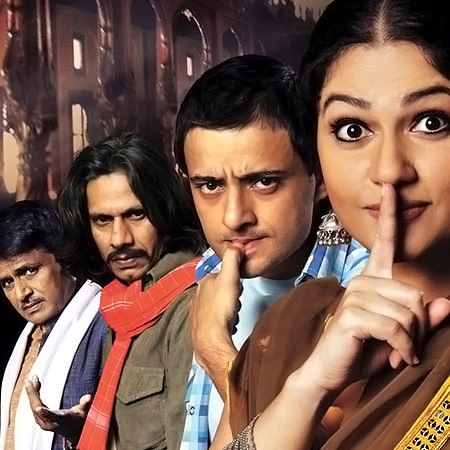
DEKH BHAI DEKH (Hindi; 2009)


Rahat Kazmi's Dekh Bhai Dekh (apparently re-named Dekh Re Dekh at some point; my DVD carried the older name) is a refreshing little film: it hearkens to the cinema of old, albeit in the streamlined garb of the contemporary "little" film. Refreshing because this look backward isn't by way of ironic distance or homage, and nor does it fall prey to the stale rehashing of older Bollywood tropes that is the hallmark of B-grade cinema. That is, with respect to the former, Kazmi's film isn't set in a small-town in U.P. because he wants to make a point about crime and violence in the heartland (the usual vehicle for representations of U.P. and Bihar in contemporary Hindi cinema), nor is he trying to depict a world impossibly remote from the (imagined) "us" in cities like Mumbai, Delhi, or London. Rather, his film just happens to be set in U.P., and does not purport to stage its setting. Or its Bollywood genealogy: I don't remember the last time I saw a song in praise of Radha and Krishna that was so unobtrusively part of a Hindi film (not surprising, given the industry's collective preference for Ferraris with crowds of skimpily clad European women serving as eye candy). And this one ("Kanha De Do Sharan") is picturized on that old masala staple rebooted, namely the protagonists -- Babli (Gracy Singh), Shyam (Siddharth Koirala), Charan (Vijay Raaz), and Yadav (Raghuvir Yadav), all in need of money, and acting on Babli's half-baked plan to steal a valuable idol from her own in-laws -- in disguise, singing a song to distract the audience within the film, in order to set the stage for a heist (as for what happens after the heist, well, there's a reason the film is billed as a black comedy). For such un-showy naturalness vis-a-vis his cinematic inheritance alone, Kazmi's film deserves to be seen.

Luckily, although the film has its limitations (most notably that the narrative could have been more gripping), there is more to enjoy here. Such as the earthy dialogs Mushahid Husain Pasha has written for Vijay Raaz's Charan, a smart aleck thief and generally lovable lowlife. It is rare that one has the pleasure of seeing Raaz on screen, and Pasha does not squander the opportunity -- Raaz deploys a Bollywoodized version of the bhaiyya-speak and drawl to great effect here (I would have loved to see some of the earthier dialogs amidst an appreciative audience in a cinema hall). The visuals are solid, but no more (however, Kazmi's and cinematographer Akash Deep's picturization of the heist song suggests an ability to put a bigger budget to good use). So too the music by Shadab Bhartiya, Abuzar, and Nayab Raja (Raaga.com adds Prem Anand to the list), although it surprises at points, especially when Raahat Fateh Ali Khan and Rajab Ali begin crooning "Sapne Bhaye Hain". The other good song could have been better: "Ladee re Ladee Najariya" is an utterly conventional "dancing girl" number, albeit elevated by the fact that Richa Sharma is singing it.

Dekh Bhai Dekh came and went with barely a ripple, and deserved better. One hopes it gets a wider audience courtesy of satellite/cable TV re-runs, and that Kazmi and Pasha get more opportunities to make their mark. And for God's sake, someone get Vijay Raaz more roles!